

Any business must look for growth opportunities. That’s a goal often achieved through cloud resource optimization. Making your entire infrastructure more efficient and scalable isn’t always an easy feat. Yet, the benefits you get are more than worth it.
Today’s article will take you through the process of cloud optimization and the best strategies to ensure it’s a meaningful change for your business. We’ll teach you how to optimize cloud instances and resources using JetBase’s years of experience in the field. Let’s begin.
What Is Cloud Optimization?
Cloud optimization is the process of adapting your cloud infrastructure to be, well, optimized. That means setting up checks and controls that allow you to waste no resources and have smart provisioning for any of your cloud apps’ needs. Choosing cloud optimization means saving money, preventing excess resource usage, and ensuring high performance.
How Relevant is the Cloud?
Learning about cloud optimization only really makes sense if it’s a process that most companies will face. Luckily, that’s exactly the case, at least according to Gartner. They estimate the 2025 cloud market at $723.4 billion, representing a significant increase from 2024. Additionally, predictions indicate that by 2029, over 50% of companies will use industry cloud platforms.
With that kind of growth, it seems like knowing about cloud optimization solutions is pretty much mandatory. However, it’s one thing to see the big picture and another to match the importance of cloud optimization to your own operations. So let’s do just that.
Why Cloud Optimization Matters
These are just general points that address why one should spend money, time, and resources on optimizing their cloud. Apply these to your own company to see if they are relevant to you.
The Importance of Cloud Optimization for Your Business
We’ve already pointed out that any company has to grow and improve if it hopes to stay relevant. While “better” is a rather subjective term, most people would agree that it involves providing higher quality of services and offering unique value propositions. We’d state that cloud computing optimization can help achieve just that by making your business more efficient.
Key Benefits of Cloud Optimization
The most common advantages of cloud resource optimization are these:
- Lower spending
- Stronger security
- Higher productivity
- Increased visibility
We hope the first point is straightforward here, as minimizing your expenses will help put money toward evolving your company. Similarly, it’s no surprise that improved security and productivity are a major bonus of cloud optimization. But the last point of visibility is just as vital, as it allows you to see operational areas that may be refined. Better visibility grants a more in-depth understanding of your strengths and ways to lean on them.
The 4 Key Areas to Optimize in Cloud Environments
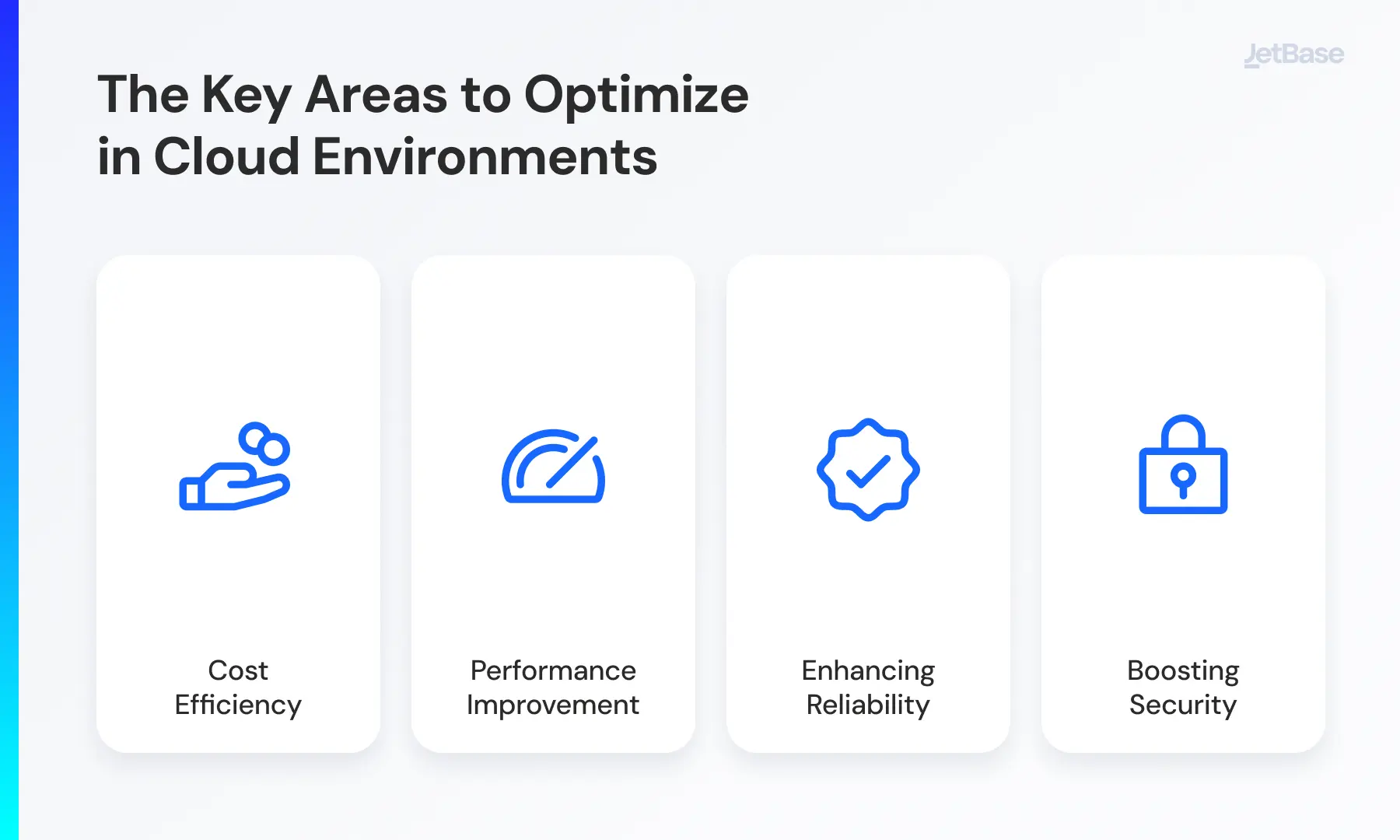
Talking about benefits is always nice, but let’s discuss where you’ll need to apply cloud infrastructure optimization to actually get them. After all, the process is a precise one and only nets positive results when you use it correctly.
1. Cost Efficiency
Deloitte suggests that companies can save up to 45% of their expenses with cloud optimization, so that’s where you should concentrate your efforts. Find applications, instances, and processes that use more resources than necessary. Alternatively, assess if you’re over-provisioning as a whole and find ways to cut into that.
2. Performance Improvement
Money isn’t everything, and cloud performance optimization is just as crucial as limiting expenses. Optimization involves finding bottlenecks and points where apps are clashing for resources. Establish protocols that control how resources are divided and use cloud optimization practices to prevent instances from leeching off each other.
3. Enhancing Reliability
One effect of cloud optimization is increased uptime for your cloud applications and services, as well as their ability to process more operations. We already mentioned that you can eliminate bottlenecks by applying cloud optimization techniques. Well, the same techniques can also help prevent any crashes and guarantee that your data is always backed up.
4. Boosting Security
Lastly, cloud performance optimization is essential to keeping your cloud infrastructure secure through monitoring and timely patching of any potential gaps in your defenses. This way, you can work with sensitive data with no worries or risk of non-compliance fines. When applied correctly, your cloud optimization should leave your cloud environment impenetrable to outside threats.
![Cloud Software Development [AWS].webp](/static/Cloud_Software_Development_AWS_a351611d38.webp)
Cloud Optimization Strategies for Success
Any process becomes more successful when approached with careful planning and the right strategy. Here’s how to actually conduct cloud optimization if you want to ensure the best results.
Effective Cloud Cost Management Techniques
If you want to ensure you’re cutting expenses through cloud optimization techniques, invest your efforts in cost forecasting and analytics. These will allow you to understand your spending better and break it down so you can see the problem areas easily. Plus, you will be able to control expenses using tools such as AWS CloudWatch.
Performance Tuning and Resource Allocation
What is cloud optimization without resource management? Use practices such as resource tagging to ensure that you’re boosting your cloud’s performance and keeping all apps running. It’s also a good idea to set up automatic scaling and caching to ensure apps load quickly and always have what they need to function.
Building Redundant Systems for Reliability
Sometimes, cloud optimization is just about having backup plans, which is exactly why you may need systems that aren’t always “on.” Create a backup infrastructure that can take over in case of downtime on the main line, preventing any full stoppage of your operations.
Securing Your Cloud Infrastructure
Again, the lynchpin in cloud optimization is creating a fully secure environment with authentication and encryption tools. You need to limit access to management controls and find ways to reinforce the measures that prevent unauthorized entry into the ecosystem.
Cloud Optimization Tools and Services to Consider
To increase your chances of success, you can rely on a set of tools and services that support your work.
Smarter Cost Management with Cloud Optimization Tools
Most public cloud platforms offer tools for cloud optimization, such as AWS CloudWatch or Azure Cost Management. These can automate a lot of the work required in dealing with cost efficiency.
Gaining Greater Visibility into Cloud Operations
Visibility is one of the core benefits of cloud optimization. Plenty of tools out there help increase it:
- Azure Monitor
- Google Cloud Operations
- Datadog
- DigitalOcean Monitoring
Many of these come bundled when you purchase the use of a public cloud platform and allow you to set up monitoring for resource usage and app performance.
Leveraging Expert Knowledge for Enhanced Optimization
In order to get the absolute most out of your cloud optimization, it’s important to have the job done by professionals. This is why it pays to work with seasoned vendors like JetBase, who know platforms such as AWS inside and out.
Best Practices for Cloud Optimization
Whether you’re doing the optimization yourself or using professional help, here are some strategies that surely lead to a more positive outcome.
Right-Sizing Cloud Resources for Efficiency
If you want your cloud optimization to limit resource waste, you should implement auto-scaling based on demand, as well as varied service selection based on process type. These steps should guarantee that your apps aren’t taking more than they need. It’s important to keep your allocation moving and adaptable to any changes, which can help avoid bottlenecks.
Maximizing Savings with Spot Instances
Spot instances are priced lower than regular ones due to the fact that they’re available sporadically and have to be requested. However, with careful planning, you can rely on these for apps that don’t run all the time and can be operated at will. This is an efficient cost-cutting method during your cloud optimization. It controls your energy usage, too.
Unlocking the Power of Reserved Instances
For those who like long-term planning and want to apply it in their cloud optimization, reserved instances can be the perfect deal. These require companies to pay the full cost or a substantial portion of it upfront while receiving a discount on the regular price. While the initial investment can be hefty, you’d be cutting up to 75% of the traditional rate, making for a lucrative deal.
Identifying and Removing Unused Cloud Resources
We’ve stressed the importance of monitoring in cloud optimization, and this is where it comes into play in a big way. You may have excess resource use from over-provisioning, orphaned resources after failed deployments, and temporary tests that weren’t shut down properly. All of these can be spotted with your internal monitoring and then removed, netting you extra resources to work with.
Consolidating Idle Resources for Better Utilization
Try to identify unused instances of VMs, cloud storage, and databases during your cloud optimization. These can fall through the cracks during mundane operations and can then be repurposed to actually run processes and allocate their resources to important tasks. Granted, this is only relevant if you haven’t been running checks for such resources prior to starting to optimize.
How JetBase Can Help You Optimize Cloud Expenses
We’ve shown you how to tackle cloud optimization and why it’s a worthwhile investment, but our help doesn’t have to end there. JetBase has over a decade of experience providing custom development and support services to companies in need. Our team can consult you on optimizing your cloud and help implement these changes to ensure the success of the process.
JetBase is ready to help at any stage of the process, and the best way to start is simple - just send us a message.