

Launching a telemedicine platform is no longer a competitive advantage it's an expectation. Patients expect virtual consultations, online scheduling, and secure digital communication to be available as part of modern care.
The real challenge today isn't whether to offer telemedicine, but how to launch it quickly without making costly technology decisions too early.
For many organizations, a white label telemedicine platform offers the fastest path to market, allowing them to validate demand, onboard providers and patients, and start delivering virtual care without spending months or even years building core functionality from scratch. For organizations evaluating a white label telehealth platform, this approach provides a practical way to launch quickly while reducing implementation risk. But choosing a white label solution isn't simply about reducing development costs, and building a custom platform isn't automatically the better long-term investment.
The right choice depends on where your business is today and where you want it to go next. Companies that succeed with white label platforms treat them as a way to validate assumptions and accelerate growth, not as a permanent solution. At the same time, organizations with mature products, unique clinical workflows, or ambitious technology roadmaps often reach a point where custom development creates far greater value.
In this guide, we'll explain what a white label telemedicine platform is, how it compares with a white label telemedicine app, who it works best for, how much it typically costs, which features matter most, and when it makes sense to move from a ready-made solution to custom development. More importantly, you'll learn how to choose the approach that best aligns with your business goals, current stage of growth, and long-term product strategy.
What Is a White Label Telemedicine Platform?
A white label telemedicine platform is a ready-made software solution that healthcare organizations can brand, configure, and launch as their own without developing the core technology from scratch. Instead of building every feature internally, organizations license an existing platform and customize it to match their brand, workflows, and business requirements.
You can think of it like moving into a fully furnished building rather than constructing one from the ground up. The foundation, including video consultations, scheduling, user management, and security, is already in place. Your organization focuses on configuring the platform, integrating it with existing systems, and delivering healthcare services.
Most white label telemedicine platforms also allow organizations to customize branding, patient and provider portals, appointment workflows, notifications, and integrations with existing healthcare systems. Some vendors also offer a white label telehealth app, allowing organizations to launch branded mobile experiences alongside their web platform.
One important distinction is that licensing a white label telemedicine platform doesn't mean owning the underlying software. The vendor continues maintaining the core product, infrastructure, security updates, and future platform improvements, while your organization manages configuration, integrations, and day-to-day operations.
For many healthcare organizations, this approach significantly reduces both development time and implementation risk. Instead of investing months or even years in building standard telemedicine functionality, they can focus on validating their business model, improving patient care, and scaling their services more quickly with a white label telehealth solution.
Who Can Benefit from a White Label Telemedicine Platform?
Many people assume white label telemedicine platforms are designed primarily for startups or smaller healthcare providers. In reality, company size has very little to do with the decision. The better question is: How much uncertainty does your business still have?
White label telemedicine platforms create the most value for organizations that need to launch quickly, validate assumptions, or expand digital services without making a large upfront engineering investment. They're particularly well suited to businesses that are still refining their product, testing market demand, or introducing new healthcare offerings.
This often includes early-stage digital health startups looking to validate an idea before investing in custom development. Private clinics and multi-location practices often adopt white label telehealth platforms to add virtual care without building an in-house software team, while hospital groups frequently adopt them for targeted initiatives such as remote follow-up programs or specialist consultations. Insurance providers and employers also benefit by extending their existing services with virtual care rather than creating a healthcare product from scratch.
Successful adopters tend to share the same mindset regardless of their size or industry. They view technology as a tool for achieving business goals rather than the goal itself. Speed matters more than complete flexibility, proven functionality is preferred over reinventing standard features, and real user feedback is considered more valuable than trying to predict every future requirement before launch.
On the other hand, organizations that already have a validated product, highly specialized clinical workflows, or proprietary technology may find that a white label telemedicine platform limits their long-term flexibility. In those situations, investing in custom development can become the stronger strategic choice.
Ultimately, white label telemedicine isn't for small companies it's for companies that want to reduce uncertainty. If your priority is learning, validating, and reaching the market faster, a white label telemedicine platform can provide the foundation you need while your business continues to evolve.
Key Benefits of a White Label Telemedicine Platform
The biggest benefit of a white label telemedicine platform isn't building software faster, it's making better business decisions sooner.
Many organizations evaluate white label platforms based on development time or implementation costs. While those advantages are real, they're ultimately the result of something much more valuable: the ability to validate assumptions, learn from real users, and invest with greater confidence.
| Benefit | Business Value |
|---|---|
| Faster market validation | Learn from real users before making major engineering investments |
| Reduced business uncertainty | Validate demand and make product decisions based on evidence rather than assumptions |
| Greater focus on competitive advantage | Invest engineering resources in patient care, clinical innovation, and business growth instead of rebuilding standard functionality |
| Better long-term product decisions | Let real-world usage shape future technology investments and product evolution |
Faster Market Validation
Launching earlier isn't valuable simply because your product reaches the market sooner. It's valuable because patients, providers, and healthcare partners begin generating real feedback that helps validate business assumptions, identify feature priorities, and reveal operational challenges much earlier than any internal planning process can.
Reduced Business Uncertainty
A white label telehealth platform allows organizations to test demand before making major technology investments. Instead of committing significant engineering resources upfront, businesses can validate their market, refine their offering, and reduce the risk of building features that users ultimately don't need.
Greater Focus on Competitive Advantage
Healthcare organizations rarely compete because they have a better appointment scheduler or video consultation module. Their advantage comes from better patient care, stronger provider networks, specialized clinical services, and exceptional patient experiences. By relying on a proven platform for standard telemedicine functionality, teams can focus their time and engineering effort where it creates the greatest strategic value.
Better Long-Term Product Decisions
One of the most overlooked benefits of a white label platform is the operational knowledge organizations gain after launch. Real-world usage provides a much clearer understanding of patient behavior, provider workflows, and future product priorities. As a result, future technology investments are guided by evidence rather than assumptions.
The companies that gain the most from white label platforms aren't the ones that launch the fastest, they're the ones that learn the fastest.
Must-Have Features of a White Label Telemedicine Platform
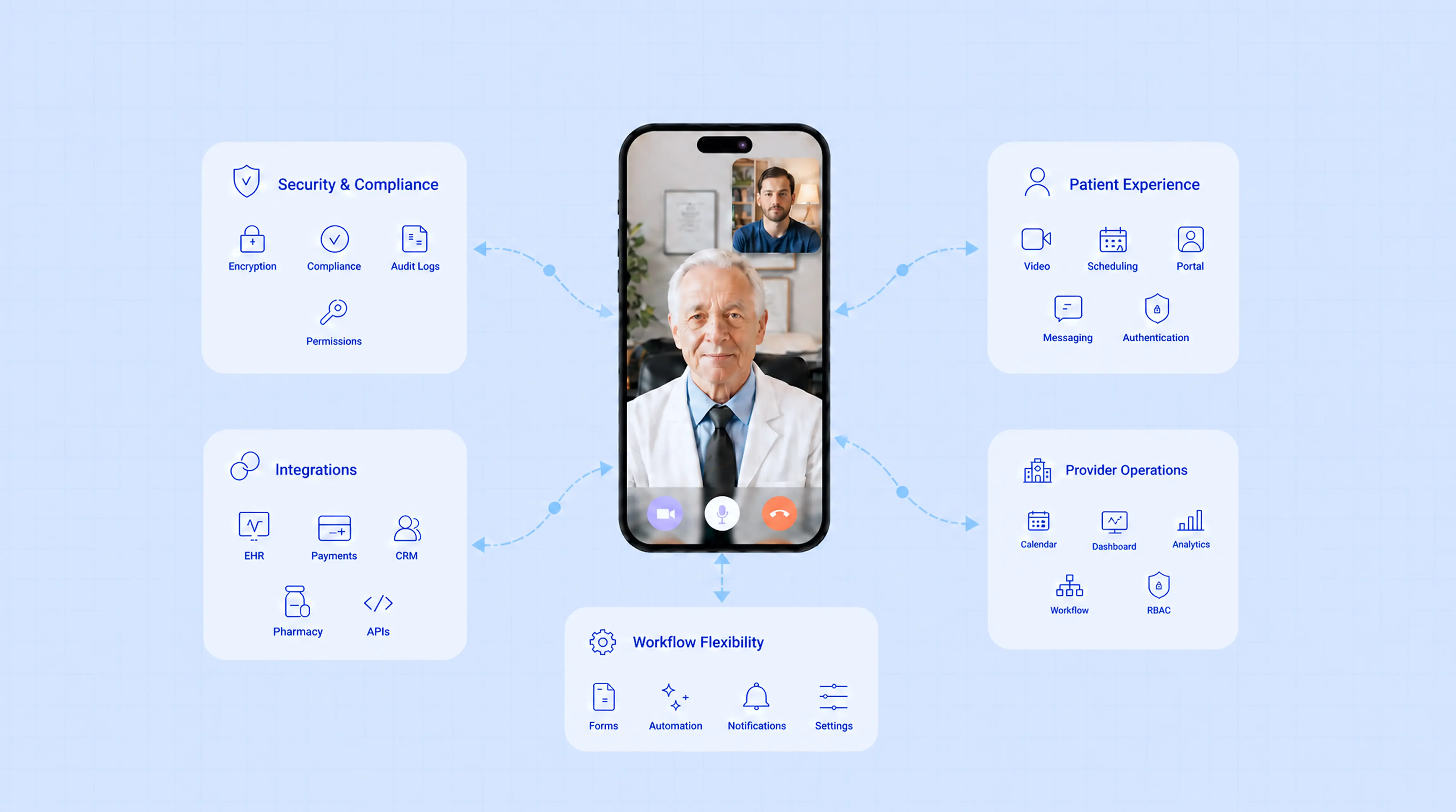
Not every feature has the same impact on the success of a telemedicine platform. While patient-facing functionality often gets the most attention during product demos, long-term success depends just as much on the tools that support providers, administrators, and day-to-day operations. When evaluating a white label telemedicine platform, look beyond the feature list and focus on whether the platform supports the entire care delivery process.
Patient Experience
These features directly shape how patients access and receive virtual care through a white label telemedicine app or web platform:
- Secure video consultations
- Appointment scheduling
- Patient portal
- Secure messaging and notifications
- User authentication
Together, these capabilities create a smooth and secure patient journey while helping reduce missed appointments and communication gaps.
Provider & Administrative Operations
Healthcare teams spend far more time inside the platform than patients do. That's why operational capabilities are just as important as the patient experience.
Look for features such as:
- Provider calendars and scheduling management
- Administrative dashboards
- Role-based access control
- Reporting and analytics
- Audit logs
- Workflow automation
These tools help healthcare organizations improve efficiency, reduce manual work, and maintain consistent clinical operations.
Integrations & Interoperability
A telemedicine platform should become part of your existing healthcare ecosystem, not another standalone application.
Essential integration capabilities include:
- EHR/EMR systems
- Payment gateways
- Laboratory information systems
- Pharmacy services
- Identity verification
- CRM and communication platforms
Just as importantly, evaluate how integrations are supported. Well-designed APIs, webhooks, documentation, and long-term maintenance often have a greater impact than the number of integrations listed on a vendor's website.
Security & Compliance
Healthcare organizations manage highly sensitive patient information, making security a core platform requirement rather than an optional feature.
Key capabilities include:
- End-to-end encryption
- Role-based permissions
- Audit trails
- Secure authentication
- Compliance support for applicable healthcare regulations
These features help protect patient data while supporting regulatory compliance and reducing operational risk.
Workflow Flexibility
Healthcare services evolve over time, and your platform should be able to evolve with them. Configurable workflows, customizable forms, notification rules, and operational settings allow organizations to adapt without requiring major redevelopment whenever clinical or business processes change. The best white label telehealth apps are designed to make these adjustments through configuration rather than extensive redevelopment.
White Label vs. Custom Telemedicine Platform
Don't choose between a white label and a custom telemedicine platform based on what your product is today. Choose based on what your business needs next.
Many organizations approach this decision by comparing features, pricing, or development timelines when evaluating a white label telehealth platform against custom development. In reality, those factors matter far less than your business strategy. White label and custom development aren't competing technologies they're different approaches to solving different business challenges at different stages of growth.
White Label vs. Custom at a Glance
| Decision Factor | White Label Platform | Custom Platform |
|---|---|---|
| Time to market | Faster launch using an existing platform | Longer development timeline |
| Upfront investment | Lower initial investment | Higher upfront investment |
| Flexibility | Configurable within platform capabilities | Fully tailored to business needs |
| Platform ownership | Vendor maintains the core platform | Full ownership and control |
| Operational responsibility | Shared with the vendor | Managed by your organization or technology partner |
| Best suited for | Market validation, rapid launch, and reducing early risk | Long-term differentiation, proprietary technology, and complex business requirements |
The Real Trade-Offs
The biggest trade-off isn't cost it's speed versus flexibility. A white label platform allows organizations to launch quickly because the core technology already exists. A custom platform takes longer to build but gives complete control over workflows, architecture, and future product evolution.
Another important trade-off is lower upfront investment versus long-term ownership. White label platforms let organizations invest gradually as the business matures, while custom development requires a larger upfront commitment in exchange for full control over the product roadmap.
There's also the question of shared responsibility versus complete responsibility. With a white label platform, the vendor manages much of the infrastructure, platform maintenance, security updates, and ongoing improvements. Choosing a custom platform means taking ownership of the entire software lifecycle from architecture and compliance to scalability, monitoring, and future development.
Perhaps the most overlooked trade-off is certainty versus optionality. White label telemedicine is often the better choice when you're still validating your business model and learning from the market. Custom development becomes increasingly valuable once you have a clear product vision and technology itself becomes part of your competitive advantage.
Common Decision Mistakes
Organizations often compare technologies when they should be comparing business strategies. Focusing only on feature lists or development costs can lead to expensive decisions that don't support long-term goals.
Other common mistakes include overestimating how much customization is actually needed before launch, underestimating the ongoing cost of owning software, or assuming every successful healthcare company must eventually migrate from a white label platform. In reality, migration only makes sense when your business has outgrown the platform, not because it's the expected next step.
Questions to Ask Before Making a Decision
Before choosing between a white label and a custom telemedicine platform, ask yourself:
- What are we trying to validate?
- How quickly do we need to launch?
- What truly differentiates our business?
- Is technology itself part of our competitive advantage?
- How much product uncertainty still exists?
- Which integrations are essential today and which may become critical as we grow?
- Do we have the engineering capacity to own and maintain a software platform long term?
- If our business doubled in the next two years, would this approach still support our goals?
The answers to these questions usually provide far more clarity than comparing feature lists or development estimates.
The right choice isn't the platform with the most features or the greatest flexibility it's the one that best supports your current stage of growth while leaving room for your business to evolve.
Every healthcare product has different business goals, technical requirements, and growth plans. We help organizations evaluate both approaches, avoid costly technology decisions, and choose the strategy that creates the greatest long-term value.
When Does It Make Sense to Move from White Label to Custom Development?
Many organizations ask when it's time to move from a white label platform to custom development. In reality, that's not the most important question.
A better one is: What has changed in your business that makes custom development valuable today, when it wasn't six months ago?
The answer is rarely a technical limitation. More often, it's a shift in business strategy, product maturity, or competitive positioning.
Signs Your Business Is Ready for Custom Development
| Business Signal | Why It Matters |
|---|---|
| Technology becomes part of your competitive advantage | You need greater flexibility to innovate |
| Critical workflows can no longer be adapted | Configuration is no longer enough to support your operations |
| Integration complexity keeps increasing | Greater architectural control becomes essential |
| Product ideas are repeatedly delayed by platform limitations | The platform is starting to slow business growth rather than enable it |
From Our Experience
We've seen both sides of this decision play out. When a growing network of physiotherapy clinics needed to replace paper-based scheduling and records, a custom Patient Management System — built with dedicated EMR, smart scheduling, and a patient portal — helped them cut administrative workload and increase appointment attendance by 23% within three months, giving them the confidence to open two new locations.
In another project, a telehealth platform built for remote doctor consultations required a multi-tenant architecture where each provider needed a fully isolated environment for patient data — a level of architectural control that's difficult to achieve within the constraints of an off-the-shelf platform.
Both cases share the same underlying signal: the organizations had outgrown configuration-level flexibility and needed the platform itself to adapt to their workflows, not the other way around.
Growth Alone Isn't a Reason to Migrate
One of the biggest misconceptions is that growing companies should automatically move to custom development. In practice, many organizations continue scaling successfully on white label platforms for years.
The real question isn't whether your business has grown; it's whether the role of software within your business has fundamentally changed. If the platform still supports your operations, integrates well with your existing systems, and enables the experience your customers expect, staying on a white label platform may remain the smarter strategic decision.
Before You Invest in Custom Development
By the time you decide to build a custom platform, your business should no longer be operating on assumptions. Ideally, you should already understand:
- How users actually interact with your product
- Which workflows create the most value
- Which features drive adoption
- Where operational bottlenecks exist
- Which integrations are essential for long-term growth
One of the biggest advantages of starting with a white label platform is that it helps generate this knowledge. Instead of designing software around assumptions, you can design it around real-world evidence gathered from everyday use.
The best time to build custom software isn't when you can afford it; it's when your business has learned enough to know exactly what it needs.
How to Choose the Right White Label Telemedicine Vendor
You're not choosing software. You're choosing the team that will help your product evolve.
Many organizations compare white label telemedicine vendors based on feature lists, pricing, or product demonstrations. While those factors matter, they rarely determine the success of a long-term implementation. A white label platform becomes part of your business for years, making the vendor's expertise, transparency, and ability to support your growth just as important as the software itself.
Vendor Evaluation Checklist
Before signing a contract, evaluate the vendor across the following criteria:
| Evaluation Criteria | Why It Matters |
|---|---|
| Healthcare expertise | The vendor should understand clinical workflows, compliance requirements, and how healthcare organizations operate, not just how to build software |
| Product roadmap | Regular releases and a clear long-term vision show that the platform will continue evolving alongside your business |
| Integration capabilities | Mature APIs, comprehensive documentation, and native integrations reduce future implementation challenges |
| Implementation & onboarding | A structured rollout process helps shorten time to value and reduces operational risk |
| Security & compliance | Ask how security updates, compliance changes, monitoring, and incident response are managed |
| Operational support | Evaluate response times, support availability, SLAs, and customer success processes, not just technical capabilities |
| Scalability | The platform should support future growth in users, providers, services, and integrations without major architectural changes |
| Customer retention | Long-term customer relationships often say more about a vendor than marketing materials or product demos |
| Commercial flexibility | Your agreement should support future customization, growth, and, if necessary, a smooth transition away from the platform |
Questions Every Healthcare Organization Should Ask
Beyond product functionality, ask questions that reveal how the partnership will work over time:
- How often do you release platform updates?
- How are new features prioritized?
- Which integrations are supported natively, and which require custom development?
- What APIs and documentation are available?
- How do you handle security updates and compliance changes?
- What implementation and onboarding support is included?
- What responsibilities remain ours, and which are managed by your team?
- What happens to our data if we decide to migrate in the future?
The answers to these questions often reveal far more about a vendor than any feature comparison or product demonstration.
Red Flags to Watch For
Be cautious if a vendor avoids discussing platform limitations, promises to support every customization request, or cannot clearly explain its architecture. Other warning signs include weak integration capabilities, poor documentation, infrequent product releases, slow communication during the evaluation process, and limited healthcare experience.
Finally, look beyond today's requirements. Ask how the platform would support your business if it doubled in size, required more complex integrations, or expanded into new services. A reliable vendor should be able to explain not only how the platform works today, but how it will continue supporting your organization as it grows.
The best vendor isn't the one with the most impressive demo; it's the one you would trust during your most challenging production incident.
How Much Does a White Label Telemedicine Platform Cost?
The lowest implementation price rarely leads to the lowest total cost of ownership.
When organizations ask how much a white label telemedicine platform costs, they're often asking the wrong question. A better one is: How much will it cost to launch, operate, and grow our business using this platform?
The software license is only one part of the total investment. Two healthcare organizations can choose the same platform and end up with very different budgets because implementation complexity, not the platform itself, is usually the biggest cost driver.
Typical Implementation Budget Ranges
The following estimates reflect typical market ranges for implementation projects. Ongoing subscription, support, and operational costs are usually billed separately.
| Organization | Typical Implementation Budget* |
|---|---|
| Startup validating an MVP | $10,000–30,000 |
| Private clinic or small healthcare provider | $30,000–80,000 |
| Multi-location healthcare organization | $80,000–200,000+ |
| Large enterprise healthcare organization | $200,000–500,000+ |
Approximate market ranges. Actual costs depend on implementation complexity, integrations, customization, and regulatory requirements.
What Actually Drives the Cost?
The platform license itself is rarely the largest expense. The biggest cost drivers typically include:
- Implementation complexity – configuration, branding, testing, and deployment
- Customization – adapting workflows, permissions, notifications, and user experiences
- Integrations – connecting EHRs, payment providers, laboratories, identity verification, and other business systems
- Compliance requirements – meeting regulatory and security expectations in different healthcare markets
- Operational scale – supporting more providers, locations, users, and services over time
In other words, you're not simply paying for software; you're paying for how well that software fits your organization.
Hidden Costs to Budget For
Many organizations focus on the subscription fee but underestimate the effort required to implement and operate the platform successfully.
| Cost | Why It Matters |
|---|---|
| Data migration | Existing patient and operational data often requires cleansing, validation, and testing before migration |
| Workflow customization | Standard workflows frequently need to be adapted to match clinical operations |
| Staff training | Providers, administrators, and support teams need time to adopt new processes |
| Internal change management | Multiple departments contribute to implementation, even when development is handled externally |
| Ongoing support | New integrations, workflow improvements, and operational changes continue long after launch |
Think Beyond the Implementation Quote
Implementation is only the beginning of the investment. Over the following years, organizations should also plan for platform subscriptions, support, additional integrations, workflow improvements, compliance updates, user growth, and ongoing operational enhancements.
That's why comparing implementation quotes alone can be misleading. A platform with a lower upfront price may become more expensive over time if it requires frequent customizations, manual workarounds, or additional operational effort. Likewise, paying for capabilities your organization will never use is an unnecessary expense.
The goal isn't to choose the cheapest platform; it's to choose the one that delivers the greatest long-term value for your business.
If you're also comparing white label platforms with custom development, explore our How Much Does Telemedicine App Development Cost? guide to understand what drives development budgets, which factors have the biggest impact on costs, and how implementation complexity influences long-term investment.
How to Successfully Launch a White Label Telemedicine Platform
Launching a telemedicine platform is only one milestone in a much broader business initiative. The most successful implementations don't focus solely on deploying software; they focus on preparing people, processes, and operations to support long-term adoption and growth.
A Successful Launch Roadmap
Successful implementations rarely happen by accident. Organizations that launch smoothly typically follow a structured process that begins long before the platform is configured and continues well after go-live. While every project is different, most successful implementations move through the following stages.
| Phase | Key Focus |
|---|---|
| Business Planning | Define business objectives, success metrics, stakeholders, and project ownership |
| Workflow Design | Map clinical and operational workflows before configuring the platform |
| Configuration & Integration | Configure the platform, connect external systems, and prepare operational environments |
| Testing & Validation | Verify functionality, integrations, security, workflows, and user acceptance |
| Training & Change Management | Prepare clinicians, administrators, and support teams through onboarding and communication |
| Go-Live | Launch with active monitoring, rapid issue resolution, and close collaboration between business and technical teams |
| Continuous Optimization | Review user feedback, operational metrics, and continuously improve workflows |
Prepare Before Implementation Begins
Strong launches are built on careful preparation. Before implementation begins, organizations should define clear business objectives, map clinical workflows, align stakeholders across leadership, operations, IT, compliance, and clinical teams, and identify the systems that will need to integrate with the platform.
Investing time in these activities helps reduce implementation risks, minimize last-minute changes, and keep the project focused on measurable business outcomes rather than technical tasks alone.
Avoid the Most Common Launch Mistakes
Many implementation delays have little to do with technology. Instead, they result from business decisions made too late in the project.
The most common mistakes include:
- Starting implementation before business requirements are fully defined
- Underestimating the complexity of integrations
- Lacking clear internal ownership and decision-making
- Setting unrealistic implementation timelines
- Treating deployment as an IT project instead of an organization-wide change initiative
Addressing these challenges early helps keep projects on schedule and reduces unnecessary rework.
Prioritize User Adoption After Go-Live
A successful launch depends on how quickly people begin using the platform effectively.
Clinicians need confidence that the platform supports patient care without adding unnecessary complexity. Administrators require operational training, while patients benefit from clear guidance and an intuitive user experience. Many organizations also find it valuable to identify internal champions who can encourage adoption across clinical and operational teams.
During the first few months after launch, focus on a small group of metrics that directly reflect your business goals, including:
- User adoption among clinicians and patients
- Appointment completion rates
- Patient satisfaction
- Provider engagement
- Scheduling efficiency
- Administrative workload
- Support ticket volume
- Integration reliability
These metrics provide valuable insights into how the platform is performing in real-world conditions and help prioritize future improvements.
Treat Launch as the Beginning, Not the Finish
Implementation doesn't end on launch day. Regularly reviewing user feedback, operational metrics, and evolving business requirements allows organizations to refine workflows, improve the user experience, and expand platform capabilities over time.
Continuous optimization helps ensure the platform continues delivering value as the organization grows and its healthcare services evolve.
Launch Your White Label Telemedicine Platform with JetBase
Choosing the right white label telemedicine platform is only the first step. Turning it into a successful healthcare product requires the right implementation strategy, seamless integrations, and continuous optimization as your business grows.
At JetBase, we help healthcare organizations navigate every stage of that journey, from evaluating white label vendors and planning implementations to integrating, customizing, and evolving telemedicine platforms as business needs change.
Whether you need Healthcare Software Development Services or specialized Telemedicine Software Development, our team helps reduce implementation risk while keeping technology aligned with your business goals.
We don't start by asking, "What should we build?" We start by asking, "What are you trying to achieve?" Sometimes the right answer is a white label telehealth solution. Other times, it's custom development. In many cases, it's a combination of both.
If you're planning a new telemedicine platform or evaluating your technology options, our team can help you define the right strategy, avoid costly implementation mistakes, and build a roadmap that supports your long-term growth.
Whether you're evaluating a white label solution, planning a custom platform, or deciding between the two, our healthcare team can help you define the right implementation strategy, reduce delivery risk, and build a solution that supports long-term growth.