

We’ve all heard the phrase “One small step for man, one giant leap for mankind.” Despite the risk of sounding cliché, this sentiment is particularly relevant for micro SaaS. These tiny solutions are cost-effective, laser-focused answers to problems that pain tons of companies. However, they still get overlooked from time to time and are compared unfavorably to regular SaaS.
So, today we’d like to address the usability of micro-SaaS and the reasons to go with this type of software over others. We’ll go over the current situation in this niche, reasons why it fits modern companies well, and how you can make a successful solution of your own. We’ll draw on JetBase’s experience to present a couple of ideas that will inspire you. By the end of this article, you will be ready to delve into the world of micro SaaS ideas in full, building a solution with JetBase.
The Rise of Micro SaaS
What is micro SaaS at its core, and what defines it? We’d single out the following qualities:
- Minor scope
- Modest budget
- Minimal workforce requirements
- Fast development
While this list contains only positive things, that doesn’t mean this niche has instantly become everybody’s favorite. Emerging around 2016, these small solutions gradually gained steam and really came into their own around 2024 and 2025.
Outlining all the factors that lead to this would take hours, but let’s look at the highlights. First, solo founders now account for 35% of the startup market, making the no-code approach to micro-SaaS lucrative. They’re easy to connect to AI tools, enhancing a simple piece of software with minimal effort. Experts indicate that niche startups solving niche issues are an ongoing trend.
Lastly, as demand for remote work rises, coordinating big SaaS projects may get tricky. Meanwhile, micro ones are relatively easy to plan, develop, and launch, giving startups plenty of opportunities to test ideas and pursue new opportunities.
Why Micro SaaS Works So Well for Modern Businesses
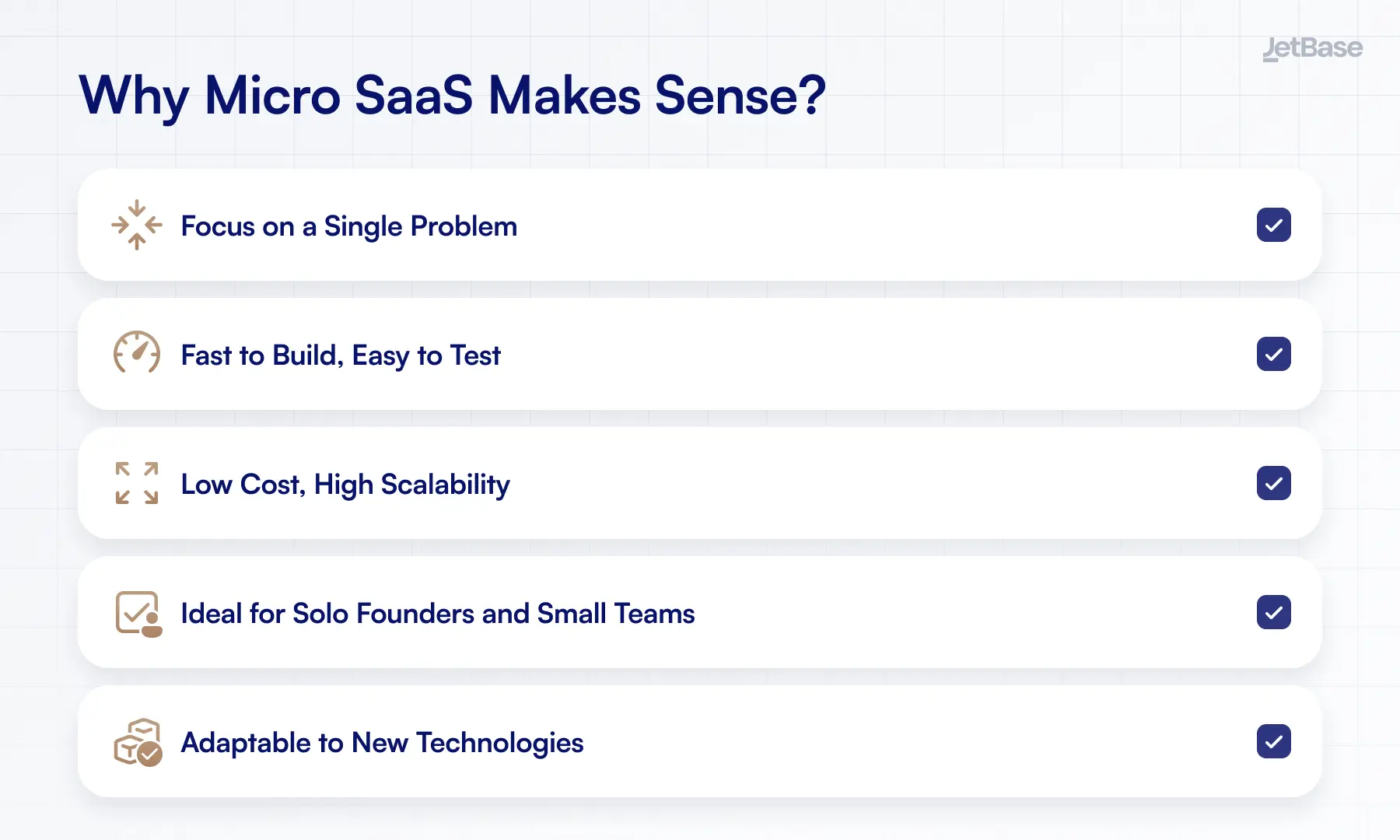
The short list in the above section may give you an idea of why businesses seek out micro-SaaS, but let’s take a closer look to see its advantages in full. This list includes the points that make it such a unique value proposition for a company.
Focus on a Single Problem
Instead of a sprawling suite that tries to address every issue in an organization, micro SaaS ideas drill down to eliminate a single specific issue. This makes them more effective and simple to operate, lowering the barrier to onboarding.
Fast to Build, Easy to Test
As we’ve pointed out, the smaller scope means you can come up with micro SaaS examples and recreate your ideas in real life within a matter of weeks. Unlike typical big SaaS platforms, these solutions integrate smoothly and can be tested more thoroughly.
Low Cost, High Scalability
Since these require less development time and keep the scope manageable, they also tend to have modest budgets. But, despite this smaller presentation, it’s fully possible to scale micro SaaS ideas up and develop them into larger, more comprehensive solutions. Therefore, they can serve as excellent proof-of-concept starters and lead to strong growth.
Ideal for Solo Founders and Small Teams
Because micro-SaaS can be built with a no-code approach, it doesn’t require a large team to put such a solution together. Moreover, it can be done solo, meaning even a tiny startup can launch its own product, establishing its name in the market.
Adaptable to New Technologies
It’s important to keep up with trends and new tech, as micro SaaS ideas 2025 was interested in may be considered completely outdated by 2027. Thankfully, because micro solutions' architecture can be so simple, you can easily update them to integrate new tech and APIs.
Inside a Successful Micro SaaS
There’s a whole other layer that makes micro SaaS ideas successful, and it’s time to talk about what influences these ventures and what guarantees they make a splash.
Clear, Narrow Value Proposition
First and foremost, a micro-solution idea is easy to sell because investors and future users can clearly see what it offers. As this type of software aims to solve minor, niche issues, it’s easier to market and target the right audience. Instead of trying to capture the entire market, you’d be selling micro-SaaS to the exact companies that need it.
Frictionless User Experience
By narrowing the scope of the product, it becomes possible to really iron out any wrinkles and deliver a solution that’s 100% polished. From iterating the design until it’s smoother than ever to extensive QA, micro solutions are a launchpad for companies willing to put in the work.
Built on Reusable or API-based Infrastructure
In addition to requiring less development time and resources due to its smaller scope, micro SaaS can be built from pre-written code blocks, reusing those created by other devs. Plus, many of its functions can be implemented through API connections.
Monetized via Subscription or Usage-Based Models
Effective monetization is the best way to recoup the cost of development, and micro is tailor-made to be an easy sell. You can market it with the subscription model, requiring users to pay monthly to use the tool. Alternatively, for software that’s used frequently, the payments can be usage-based to compensate for the cloud resources you’ll be billed for.
Building Your Own Micro SaaS
All the above benefits and strengths hopefully made you eager to develop your own micro SaaS examples in fields like healthcare or fintech. So now it’s time to discuss the steps of actually creating these products.
While the process below focuses on building a lean micro SaaS, the same principles apply to larger SaaS products. Before moving into development, use our guide to SaaS product design to map user journeys, define workflows, and create testable prototypes. For a deeper look at implementation, see our complete guide to SaaS application development.
Identify a Tiny but Urgent Problem
Scour communities related to your field and analyze what the people are saying, finding a common complaint thread. This can be the lynchpin of your idea, using a real-world issue that you solve. For example, take a look at Hiver - a simple AI-powered customer support solution. It doesn’t offer anything revolutionary but addresses the problem that massive CRM suites struggle to solve.
Validate Before You Code
Confirm your idea has legs by discussing it with industry leaders, such as CEOs, consultants, and investors. They can help vet your business plan and provide insight into ways to quickly improve your pitch.
Build the MVP With No-Code or Lightweight Stack
To create the first viable version of your product, you can use a minimal team that crafts it with an accessible tech stack, such as JetBase’s planner SaaS. If, however, you’d like to do things yourself, you can take up a no-code approach to minimize the skills needed. Don’t worry about future versions, as you can always hire a team later.
Test in a Real Environment
Circle back to the same communities you relied on for conceptualization and validation, as they can experience your product in real-world environments. This will allow them to not only spot technical issues but also point out flaws in the experience or design. After all, what is micro SaaS that doesn’t appeal to its target users?
Launch, Collect Data, Adapt
Once your product is ready for the world, set up the necessary analytics tools and launch it. The tools will collect the usage data and visualize it, letting you know exactly what works and what could use improvement, as well as your product’s potential for growth. As this information comes in, expand with the help of a SaaS development team like JetBase.
10 Micro SaaS ideas for 2026
Now that you’re equipped to create a product of your own, let’s look at some inspiring micro SaaS ideas 2026 has to offer. These are just ten things that could work in the upcoming market situation, and we hope they provide enough food for thought to any aspiring SaaS founder.
1. Auto Timestamping for Video Ads
Businesses can find the optimal spots to place their ads in high-traffic moments in videos. This maximizes views and interactions, allowing more precise and effective marketing campaigns.
2. Instant AWS Idle-Resource Detector
Plenty of companies use AWS as their platform of choice, but not everyone works to optimize their resource consumption. Leaving resources idle not only risks slowing services and reducing processing, but also, for those on a usage-based payment model, creates extra costs. This tool would automatically and instantly identify idle resources and warn admins, preventing these issues.
3. Ad Slot Overlap Detector
An overlap in an ad slot can mean that businesses that paid for the ad space will cite breach of contract. These things happen when something in the app or platform breaks, causing two ad pieces to be placed in one slot and disrupting their presentation. Getting a timely warning about this might just save a company from a major headache or even a lawsuit.
4. Coupon Performance Analyzer
An eCommerce idea for a tool that tracks how often customers use a specific discount coupon, how large their orders are, which sources the usage comes from, etc. This allows a commerce business to understand whether coupons are underperforming or not.
5. Auto-Summary for Telemedicine Calls
Micro SaaS can also be quite helpful in healthcare, for example, with a simple tool that records and summarizes calls between doctors and patients. This helps medical professionals focus on the call while the app essentially takes notes for them. Meanwhile, patients can use it as a reminder of the doctor’s suggestions and directions.
6. Real-Time Inventory Mismatch Notifier (Retail)
Spotting an inventory discrepancy too late can mean running out of a popular product during sales season. Thus, an automated warning system that notifies store management of any missing shipments or insufficient stock can be a lifesaver for retail businesses.
7. Drug Interaction Analyzer
Another medical micro SaaS, this tool can help doctors prescribe exactly the right medication to patients with pre-existing health issues or ongoing drug intake. It uses an extensive database to compare medications and determine whether any have conflicts or cause unpleasant side effects.
8. Micro Focus Subscription Management Tool
Businesses may rely on dozens of subscription-based services at once, making invoice collection and payment a real hassle. Automating these operations is simple enough, yet many companies will gladly pay for just such a tool, making this a prime opportunity for SaaS.
9. AI Receipt Classifier
Micro SaaS can be used to prevent fraud by comparing receipts and spotting those that may be AI-generated. This allows businesses to deny fraudulent invoices, insurance companies to notice erroneous claims, and generally serves to stop financial crime.
10. Copyright Checker for Audio or Visuals
Lastly, micro SaaS can be helpful in scouring content, using AI models to verify that media, whether hosted locally or uploaded to online platforms, isn’t breaching copyright. This can be useful for both content creators and media companies trying to protect their intellectual property.
| Solution | Industry | Complexity |
|---|---|---|
| Auto Timestamping for Video Ads | Marketing | Simple |
| Instant AWS Idle-Resource Detector | Any | Simple |
| Ad Slot Overlap Detector | Marketing | Simple |
| Coupon Performance Analyzer | eCommerce | Simple |
| Auto-Summary for Telemedicine Calls | Healthcare | Simple |
| Real-Time Inventory Mismatch Notifier | Retail | Medium |
| Drug Interaction Analyzer | Healthcare | Medium |
| Micro Focus Subscription Management Tool | Any | Simple |
| AI Receipt Classifier | Fintech | Advanced |
| Copyright Checker for Audio or Visuals | Content production | Advanced |
Key Challenges When Building Micro SaaS and How to Overcome Them
Before we finish our coverage of micro SaaS, let’s talk about the potential roadblocks that startup founders run into. While this niche may be more accessible than most, it still has its challenges, and we’ll help you solve them. They are:
- Market saturation
- Short product lifespan
- API dependence
- Limited revenue
First up is the question of an overstuffed market, which leaves very little space for new ideas to break through. Worse yet, if the idea is more of an iteration on existing solutions rather than a wholly new thing, it’s likely to flounder as well. The trick here is to validate extensively and ensure your micro SaaS brings something unique to the market.
Then consider whether your product is something users will need long-term, or perhaps you’ve accidentally made it too good, creating a one-time solution. Sure, it will have a solid reputation, but without long-term prospects, you’d quickly have to move on to a new idea. Try to focus your product on being a reusable tool that retains customers.
Third, the ability to build your micro SaaS around third-party APIs may usually be a blessing, but it can be dangerous, too. Basically, if you rely on them for specific functionality in the software, these APIs being restricted or deprecated may force you to replace them. The simple answer here is not to use them for core elements and to build your own alternatives as soon as they become viable.
Building a flexible architecture from the start also reduces long-term technical risks. These topics become even more important as your product grows. For a deeper look at scalable architecture, API integrations, and long-term technical planning, see our complete guide to SaaS application development.
Lastly, while they can be easy to monetize in terms of building the value proposition and picking a model, there’s only so much that you can earn from a single micro product. The amount scales with your user base but doesn’t reach the revenue levels of a large platform. Thus, if you want to keep growing your income, you’ll have to push for new products.
| Problem | Solution |
|---|---|
| Market saturation | Validate the idea extensively, bank on killer features |
| Short product lifespan | Prepare follow-up ideas, expand the product toward a bigger scope |
| API dependence | Build backup solutions, avoid basing core functions on third-party tools |
| Revenue cap | Launch multiple micro-products, grow your user base |
Need a Hand Bringing Your Micro SaaS Idea to Life?
We’ve shown you the possibilities of micro SaaS and the insider tips that will help you get around the challenges that other founders face. However, our ability to help doesn’t end there, as JetBase has more than a decade of experience creating SaaS solutions. Our team is tightly-knit and professional, always following a strict work ethic and professional communication standards.
So if you want your micro product to make a macro impact, bringing ambitious ideas to life with a deserved level of polish, reach out to us and let’s collaborate.