
The SaaS market continues to grow, but growth alone doesn’t guarantee success. Even in a large and expanding market, building a product is not enough — it has to solve a real problem, for the right audience, and in a way that makes business sense.
In this article, we’ll explore SaaS ideas across different industries and use cases. This includes both simple SaaS ideas that can be validated quickly and more complex SaaS startup ideas for 2026 that require deeper technical investment and planning. Some of them are easier to implement, while others are more complex. However, all of them are based on one principle: a product only works if it delivers real value and fits into an existing workflow.
Before diving into the ideas, it’s important to understand how to evaluate whether a SaaS product is worth building in the first place.
Why 2026 is the best year for niche-focused SaaS
The SaaS market is growing, but it is also becoming more competitive. Large platforms already cover general use cases, but they often don’t fully solve specific problems in particular industries or workflows. This creates space for niche SaaS products. Many of the most profitable SaaS ideas 2026 come from these focused use cases rather than broad, generic platforms.
A focused product is easier to explain, easier to market, and easier to validate. It targets a clear audience and solves a clear problem, which increases the chances of reaching product-market fit faster.
In practice, niche products also tend to have lower customer acquisition costs (CAC) and higher lifetime value (LTV), because they solve more specific and relevant problems for their users.
That’s why in 2026, success is less about building a universal solution and more about building a product that fits a specific use case really well.
Solving a Narrow but Painful Problem
General-purpose tools like CRM or ERP systems are widely used, but they don’t cover every operational need. Many companies still face specific problems that are not fully solved by existing platforms. A SaaS idea becomes viable when it solves a problem that is popular, painful, and expensive. This is why many SaaS ideas to make money are built around specific operational or financial problems.
In practice, this means:
- the problem happens regularly;
- it creates real costs (time, money, or risk);
- and companies already feel the impact of not solving it.
A useful way to evaluate this is simple: if the cost of living with the problem is higher than the cost of the solution, the product makes sense. This is why niche SaaS products often perform better. They focus on a smaller set of problems, but solve them more effectively.
They are:
- easier to position;
- cheaper to market (lower CAC);
- more likely to retain users (higher LTV);
- and often face less direct competition.
Another critical factor is validation. Interest alone is not enough. Positive feedback can be misleading, as it is often influenced by politeness or initial excitement. What matters is user behavior and willingness to pay.
Here’s how to distinguish real demand from hype:
| Signal | Real Demand | Hype |
|---|---|---|
| User behavior | Returns regularly and uses the product in workflows | Tries once out of curiosity |
| Payment intent | Asks for pricing, pays, or joins paid pilots | Says it’s “interesting” but takes no action |
| Workflow integration | Replaces manual work or existing tools | Remains a side experiment |
| Retention | Comes back because the problem persists | Drops off after initial interest |
| Referrals | Recommends the product to others | Gives positive feedback but doesn’t share |
Another important signal is competition. The presence of competitors usually means that the problem has already been validated by the market. The goal is not to avoid competition, but to understand whether you can compete effectively and offer a better or more focused solution.
By focusing on a narrow and genuinely painful problem, you increase the chances of building a product that users rely on — not just try once and forget. In practice, the most successful SaaS project ideas are those that solve a specific problem deeply rather than trying to cover too many use cases at once.
The “Boring SaaS” Advantage — Proven Categories with New Angles
Many founders try to build something completely new or “revolutionary.” But in practice, most successful SaaS products are built around problems that already exist and are well understood.
This is often referred to as “boring SaaS.”
In this context, “boring” does not mean weak or uninteresting. It means the product solves a familiar, recurring problem that businesses already recognize and are often already paying to fix. These products don’t rely on hype — they rely on real demand. The key advantage of this approach is predictability. When you build within an existing category, you already know:
- who your users are;
- what problem they are trying to solve;
- how they currently solve it;
- and how much they are willing to pay.
This makes validation faster and reduces the risk of building something the market doesn’t need. Another important factor is that proven categories are easier to distribute. You don’t need to educate the market from scratch — you compete on execution, positioning, and specialization. Compared to more experimental ideas, “boring” SaaS products often lead to more stable and scalable businesses.
Here’s how they compare to cutting-edge product bets:
| Characteristics | “Boring” SaaS (Proven Categories) | Cutting-edge SaaS |
|---|---|---|
| Problem clarity | Clear, known, already painful | Often unclear or not yet fully defined |
| Market validation | Already validated by competitors | Needs to be proven from scratch |
| Willingness to pay | Easier to confirm (existing budgets) | Harder to validate early |
| Development risk | Lower, due to known requirements | Higher, due to uncertainty |
| CAC (Customer Acquisition Cost) | Typically lower (clear ICP and messaging) | Often higher (requires education) |
| LTV (Lifetime Value) | More predictable and stable | Less predictable |
| Distribution | Easier — existing channels and demand | Harder — requires market education |
| Time to validation | Faster (can test quickly) | Slower (needs more iteration) |
| Revenue pattern | Steady, retention-driven | Volatile, trend-dependent |
This is why many so-called “boring” SaaS products outperform more innovative ones. They solve problems that are already part of daily operations, which makes them easier to sell, easier to adopt, and easier to retain users over time.
That doesn’t mean cutting-edge ideas should be avoided. But they require significantly more validation, stronger distribution, and higher tolerance for risk.
For many founders — especially in early stages — building within a proven category with a clear niche and a painful problem is a more reliable path to product-market fit.
18 SaaS Product Ideas That Can Actually Make Money in 2026
Below is a curated list of SaaS business ideas that reflect real market demand and can be considered among the best SaaS ideas for founders in 2026.
1. Niche Subscription Management
Target: Small to medium-sized businesses.
Why it's a good niche: Companies are drowning in "zombie" subscriptions. This tool finds overlaps and suggests cuts.
JetBase Insight: Success depends on secure API integrations with banking tools (e.g., Plaid).
Revenue Model: Monthly subscription or % of detected savings. | Complexity: High.
2. Proposal Generator for Niche Businesses
Target: Specialized service providers (construction, high-tech consulting).
Why it's a good niche: Manual proposals are a bottleneck. AI pulls data from previous contracts to create a quote in minutes.
Revenue Model: Per-user monthly fee. | Complexity: Medium.
3. Lab Report Summarizer (Healthcare)
Target: Private clinics and diagnostic centers.
Why it's a good niche: Doctors are overwhelmed by data. AI-native summaries highlight clinical risks instantly.
Compliance: Requires strict HIPAA/GDPR and HL7/FHIR standards.
Revenue Model: Per-report fee or enterprise license. | Complexity: High.
4. Content Repurposing Tool for Social Media
Target: Marketing agencies and content creators.
Why it's a good niche: Creating content for 5+ platforms is exhausting. This tool adapts intent and tone for each specific niche.
Revenue Model: Monthly subscription. | Complexity: Low.
This is also one of the more simple SaaS ideas to launch, but harder to differentiate in the long term.
5. Feedback Aggregation
Target: Product managers and SaaS companies.
Why it's a good niche: Feedback is scattered across Slack, email, and reviews. This tool centralizes it into actionable insights.
Revenue Model: Tiered subscription. | Complexity: Medium.
6. Clinical Data Compliance Monitor
Target: Healthcare tech startups and labs.
Why it's a good niche: Manual compliance checks are risky. This tool provides real-time audit trails for patient data.
Revenue Model: Annual contract or per-node fee. | Complexity: High.
7. Follow-up Scheduler for Telehealth
Target: Telemedicine platforms and private practitioners.
Why it's a good niche: Patient adherence drops without structure. Automated, personalized follow-ups improve outcomes.
Revenue Model: Per-patient or monthly fee. | Complexity: Medium.
8. Compliance Audit Tracker
Target: Fintech, logistics, and regulated manufacturing.
Why it's a good niche: Audit prep is usually a last-minute panic. This tool keeps documentation "audit-ready" 24/7.
Revenue Model: B2B Subscription. | Complexity: Medium.
9. Internal Data Synchronization Tool
Target: Mid-market enterprises with fragmented IT stacks.
Why it's a good niche: Inconsistent data across CRM and ERP leads to errors. This acts as a "source of truth" engine.
Revenue Model: Enterprise license based on data volume. | Complexity: High.
10. Cloud Cost Governance & Waste Tracker
Target: Tech-heavy companies and DevOps teams.
Why it's a good niche: Cloud bills (AWS/Azure) grow uncontrollably. This tool identifies idle resources in real-time.
Revenue Model: % of saved cloud spend. | Complexity: High.
11. Inventory Analytics (Retail)
Target: eCommerce brands and local retailers.
Why it's a good niche: Overstocking kills cash flow. AI-driven demand forecasting prevents stockouts and waste.
Revenue Model: Monthly subscription based on SKU count. | Complexity: Medium.
12. AML & Fraud Pattern Intelligence Platform (Fintech)
Target: Neo-banks and payment processors.
Why it's a good niche: Rule-based systems fail against modern fraud. This tool uses pattern recognition to flag suspicious moves.
Revenue Model: Per-transaction fee or monthly license. | Complexity: Very High.
13. Ad Asset Lifecycle Manager (Marketing)
Target: Performance marketing teams and ad agencies.
Why it's a good niche: Teams lose track of which visuals drive ROI. This tool links assets directly to performance data.
Revenue Model: Monthly subscription. | Complexity: Medium.
14. Employee Lifecycle Analytics (HRMS)
Target: HR departments in companies with 100+ employees.
Why it's a good niche: Decisions on churn are often based on "gut feeling." This provides predictive data on employee engagement.
Revenue Model: Per-employee monthly fee. | Complexity: Medium.
15. Returns & Exchange Automation Hub (eCommerce)
Target: Shopify/Magento-based online stores.
Why it's a good niche: Manual returns are an operational nightmare. Automation turns returns into customer loyalty.
Revenue Model: Monthly fee + per-return fee. | Complexity: Medium.
16. Fleet Maintenance Scheduler (Logistics)
Target: Trucking companies and delivery fleets.
Why it's a good niche: Unplanned breakdowns are 3x more expensive than maintenance. IoT-driven scheduling saves millions.
Revenue Model: Per-vehicle monthly fee. | Complexity: High (IoT).
17. Green Fleet Optimization
Target: Logistics companies under ESG pressure.
Why it's a good niche: Companies must report and reduce CO2. This tool optimizes routes for both speed and fuel efficiency.
Revenue Model: Monthly subscription. | Complexity: Medium.
18. Farm Resource Management System (Agriculture)
Target: Modern commercial farms.
Why it's a good niche: Resources like water and fertilizer are becoming scarcer. Dashboard tracking ensures sustainable scaling.
Revenue Model: Annual license per hectare/facility. | Complexity: High (IoT).
To better compare these SaaS ideas 2026, here is a breakdown of their target industries, business value, and technical complexity.
| # | SaaS Concept | Target Industry | Key Business Value | Tech Complexity |
|---|---|---|---|---|
| 1 | Subscription Management | General Business | Cost reduction & waste tracking | High |
| 2 | Proposal Generator | Niche Services | Faster sales & automated quotes | Medium |
| 3 | Lab Report Summarizer | Healthcare | Faster clinical decision-making | High (HIPAA) |
| 4 | Content Repurposer | Marketing | Multi-platform content scaling | Low |
| 5 | Feedback Aggregation | Product Teams | Centralized user insights | Medium |
| 6 | Compliance Monitor | Healthcare | Real-time regulatory safety | High |
| 7 | Telehealth Follow-up | Healthcare | Improved patient adherence | Medium |
| 8 | Compliance Audit Tracker | Fintech / Logistics | 24/7 audit readiness | Medium |
| 9 | Data Synchronization | Enterprise IT | Single "source of truth" for data | High |
| 10 | Cloud Cost Governance | Tech / DevOps | 20-30% infra cost savings | High |
| 11 | Inventory Analytics | Retail / eComm | Accurate demand forecasting | Medium |
| 12 | AML Fraud Intelligence | Fintech | Advanced fraud prevention | Very High |
| 13 | Ad Asset Manager | Marketing | Creative ROI tracking | Medium |
| 14 | Lifecycle Analytics | HR Tech | Lower employee turnover | Medium |
| 15 | Returns Automation | eCommerce | Operational efficiency & loyalty | Medium |
| 16 | Fleet Maintenance | Logistics | Reduced unplanned downtime | High (IoT) |
| 17 | Green Fleet Opt. | Logistics | ESG compliance & fuel savings | Medium |
| 18 | Farm Management | Agriculture | Resource efficiency & yield | High (IoT) |
How to Validate a SaaS Idea Before Building It
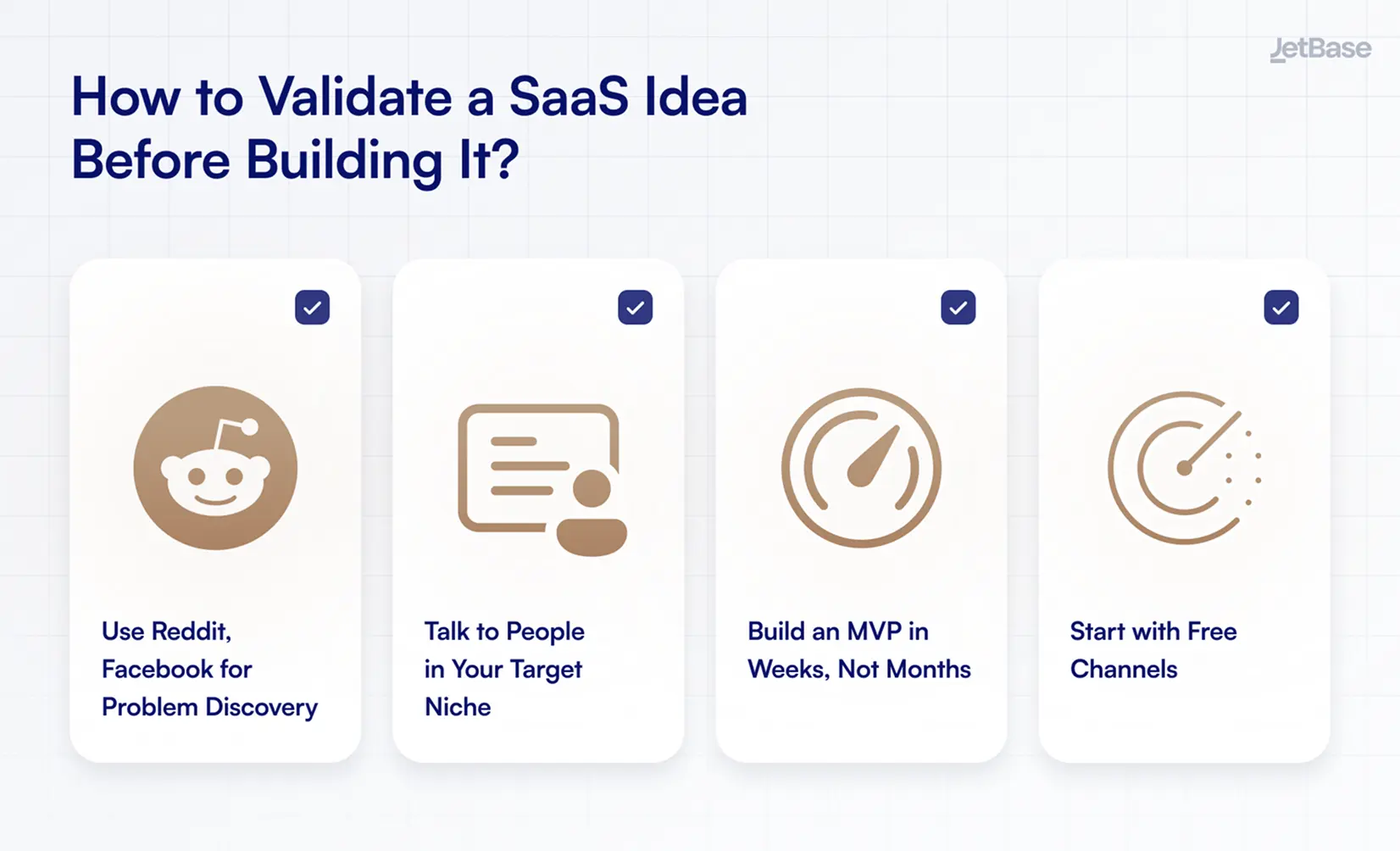
Validating a SaaS idea is not about collecting opinions — it’s about identifying real problems, real demand, and real willingness to pay. Many products fail not because they are poorly executed, but because they were built for problems that are not painful enough or not frequent enough. This is a critical step when evaluating both early-stage and innovative SaaS ideas 2026.
Phase 1: Problem Discovery via Digital Communities
Communities like Reddit, Facebook groups, and niche forums are the fastest ways to identify friction in daily workflows. However, it is critical to distinguish between a simple complaint and actual buying intent.
Market Signal Analysis:
| Type of Feedback | Characteristics | Typical Examples |
|---|---|---|
| Noise (Complaints) | Vague, low emotional intensity, no action taken. | "This tool is annoying," “I wish this was better.” |
| Signal (Demand) | Detailed, mentions workarounds, discusses lost time/money. | "We lose 5 hours a week on this," "We use 3 different tools to hack a solution." |
Key Indicators of a Valid Opportunity:
- The same issue is mentioned repeatedly by different users.
- Specific, detailed complaints rather than generic frustration.
- Users actively ask for recommendations or mention switching tools.
Phase 2: Direct Niche Validation
Community research provides a starting point, but direct conversations provide depth. The goal is to understand the current "cost of the problem."
Effective Validation Questions:
- How are you solving this problem today?
- What is the most frustrating part of this process?
- How much time or money does this cost you annually?
- Have you tried other solutions? Why didn’t they work?
Pattern Recognition: Patterns usually appear after 8–15 conversations. If multiple people describe the same problem in similar terms, it is a strong validation signal.
Red Flags to Watch For:
- Vague answers like "it’s fine" or “not a big deal.”
- Polite interest without commitment to next steps.
- Feedback from users who are not the actual decision-makers/budget holders.
Phase 3: Technical MVP Strategy
A real MVP (Minimum Viable Product) is the simplest version that delivers core value. At this stage, speed and feedback loops are more important than perfect architecture.
The MVP Technical Scope:
- Solve one core problem: Avoid feature creep.
- Essential features only: Skip advanced UI/UX or complex edge-case handling.
- Technical shortcuts: Use third-party services (APIs) instead of building custom in-house engines for non-core functions.
An MVP is "good enough" when users can experience the core value and you can measure basic usage patterns. Don't invest in high-scale architecture until you have your first 100 paying users.
Phase 4: Testing Willingness to Pay
Interest is not validation. The strongest signal of a viable SaaS idea is a financial commitment.
Ways to Test Pricing Early:
- Offering pre-orders or early access at a discount.
- Running paid pilots with a limited group of users.
- Setting up pricing pages with sign-up tracking (the "Smoke Test").
Signs of Non-Conversion:
- Users avoid pricing discussions.
- Constant requests for "free versions" without seeing the ROI.
- Interest remains high, but no action is taken toward a commitment.
Phase 5: Distribution & Scalability
A good product without a distribution strategy will fail. Before scaling, you must answer:
- Where will the first 50 users come from?
- Is the Customer Acquisition Cost (CAC) sustainable compared to the Lifetime Value (LTV)?
Once the idea is validated and its distribution path is clear, use our guide to SaaS product design to map user journeys, structure workflows, create prototypes, and refine the UX before development begins.
Validate your concept, define the right MVP, and build a SaaS product that solves real business problems. Our team helps founders move from idea to launch with a scalable technical foundation.
Development and Cost Factors for SaaS in 2026
Building a SaaS product is about making a series of technical and business decisions that directly impact your time-to-market, scalability, and long-term costs. In 2026, the biggest advantage comes from building fast and avoiding unnecessary complexity. This is especially relevant for founders evolving ideas from 2025 into scalable SaaS products in 2026.
Tech Stacks for Fast MVPs
Choosing the right tech stack is about optimizing for speed and talent availability. We recommend well-established stacks like Node.js, Python, and React. The choice of architecture and tools directly impacts how quickly SaaS ideas can be turned into real, usable products.
Why these stacks work:
- Large developer pools: Easier hiring and scaling.
- Strong ecosystems: Thousands of ready-to-use libraries.
- Faster cycles: Speed up the journey from idea to launch.
- Adaptability: Systems are easy to modify as your assumptions change.
No-code and Low-code Options
No-code solutions are powerful tools for early-stage validation, though they come with a trade-off:
| When to use No-code | The Limitations |
|---|---|
| Validating an idea quickly | Reduced flexibility for complex logic |
| Building internal tools | Dependency on third-party platforms |
| Testing workflows before full-scale dev | Potential scalability constraints |
Pricing Models That Work
Pricing directly affects product design and user behavior. In 2026, many successful products use a hybrid approach aligned with the value delivered:
- Subscription: Predictable recurring revenue.
- Usage-based: Ideal for AI-driven products (pay-as-you-go).
- Tiered pricing: Allows users to scale as they grow.
- Freemium: Lowers the entry barrier for product-led growth.
This is especially important when turning SaaS product ideas into sustainable businesses. The key rule is simple: your Lifetime Value (LTV) must significantly exceed Customer Acquisition Cost (CAC) for the business to be viable.
7 Cost Drivers Founders Often Underestimate
Development is only one part of the equation. Many founders overlook these critical expenses:
- Integration Complexity: Connecting with third-party APIs often takes longer than expected.
- Data Infrastructure: Storing and analyzing data at scale can spike costs over time.
- Security and Compliance: Essential for Healthcare or Fintech (HIPAA, GDPR).
- Ongoing Maintenance: Updates, bug fixes, and 24/7 monitoring.
- Scaling Costs: Moving from 100 to 10,000 users requires architectural changes.
- Team Overhead: Communication and management costs grow as the team expands.
- Cloud Waste: Overpaying for unused or inefficient AWS/Azure resources.
The biggest cost mistake is overbuilding too early — investing in complexity before validating demand.
Have a great SaaS idea? We’ll make it real.
This guide gives you a clear foundation for evaluating and building SaaS ideas in 2026. But turning an idea into a successful product requires more than just strategy — it requires the right execution. To ensure that your SaaS product ideas get the care they deserve, partner with JetBase to design and build your solution the right way from the start.
Whether you are working on early concepts or refining existing SaaS business ideas, the right technical execution is what turns ideas into scalable products.
With over 11 years of experience, our team has built SaaS solutions across industries — from CRM systems to complex marketing platforms. We focus on delivering software that solves real problems, scales with your business, and creates measurable value. If you're ready to turn your SaaS idea into a real product, send us a message — we’ll start with a quick call.