

Discussing the cost of implementing EHR is impossible without considering the numerous benefits associated with it, which make up for the initial expenses.
For example, clinical research suggests that EHRs may boost communication among clinicians. One study found that the proportion of clinicians who agreed that communication improved rose from 72% to 93% over 12 months after implementation. Another study reported that 80% of physicians view EHRs as a positive force in disease management.
Despite these advantages, certain regions and countries, such as Ethiopia, report a readiness to implement EHR at just 52.8%. This is a result of both apprehension about the cost of implementing EHR in hospital environments and a lack of technical know-how. Today’s guide aims to remedy that, showing ways to limit expenses and simplify integration for medical purposes.
What is an EHR System and What Are the Costs Involved?
EHR, or Electronic Health Records, contain all relevant patient information in a digital format. An EHR system is the software that allows doctors to store, manage, and secure those records.
When talking about the cost of EHR, we typically mean the price of building this software or purchasing a license, as well as ongoing maintenance costs. Plus, depending on your infrastructure, it might need to include hardware updates and integration expenses. Moving data from a legacy system to a whole new software can boost the EHR implementation cost.
EHR Implementation Cost Breakdown
Before we proceed, let’s list the standard expense categories associated with EHR. This includes:
- Software licensing/creation
- Hardware purchases
- Integration and migration
- Staff training
- Maintenance
System Selection and Licensing
The first choice you make also influences the final cost of EHR systems for hospitals.
Ready-Made EHR Solutions
You can opt for a “mass-market” system that has baseline features and requires paying a subscription fee every month. This lowers the cost of initial adoption but ends up costing extra after some years of use. It also lacks the flexibility of custom software, offering generalized functionality.
Custom EHR Solutions
Building your own system requires a sizable upfront investment but comes with the benefit of choosing precisely how it will work, what the tech stack will be, and how it will grow over the years. As a result, you have a system with some longevity that doesn’t require extra payments and may help you get an edge over the competition.
Hardware Requirements
Some hospitals run legacy systems that won’t support newer EHR software, requiring investments in hardware. Others may be easy to integrate with, but could benefit from having dedicated devices.
Workstations and Tablets
Having these in sufficient numbers can increase the cost of implementing EHR, as you want every department to have access to the system, with the relevant devices reserved for that purpose. As a result, you may be looking at buying dozens of new pieces of hardware.
Servers and Networking Equipment
Supporting an intricate EHR system that connects hospitals and departments will likely require more hardware than you have now. The exception to this would be institutions that already have major networks in place and can have the two systems share the hardware.
Integration and Data Migration Costs
Connecting your existing software and databases to the new EHR system and transferring all the data to it securely and in an error-proof way is a time-consuming process. It also requires quite a bit of technical resources and knowledge, increasing the cost of EHR systems.
Training and Support Expenses
You will also have to spare a portion of your budget to onboard the staff, as the lack of standardized solutions and support programs is one of the main challenges here. Plus, if you’re going to use an off-the-shelf solution, you will be spending a bit on support queries to get proper help.
Ongoing Maintenance and Upgrades
Once your system is in place, there is one last point to add to the total cost of EHR, as the software will inevitably require updates to incorporate new technology and additional features. Meanwhile, the hardware it runs on will require maintenance, which further raises expenses.
| Category (for custom software) | Average cost |
|---|---|
| Development expenses | $150,000 - $500,000 |
| Hardware cost | $5,000 - $50,000 annually |
| EHR implementation cost | $10,000 - $50,000 |
| Onboarding cost | $3,000 - $15,000 |
| Software update cost | $1,500 - $5,000 annually |
| EHR maintenance cost | $24,000 - $60,000 annually |
Factors Influencing the Cost of EHR Implementation
Your cost of Electronic Health Records systems will always be affected by a certain range of changing factors, which can be used to your advantage when necessary.
Size and Complexity of Your Organization
The bigger your company, the more data and points of entry you will be working with, and the more resilient the software has to be. As a result, the average cost of EHR implementation goes up as the business size grows.
Customization Requirements
Adjusting the standard EHR system structure to tailor it to your business will come with extra expenses too, as each new feature or compatibility tweak comes with its own price tag. So if your core priority is keeping the cost of EHR implementation low, consider going with a simple system.
Regulatory Compliance and Industry Standards
Medical software has strict regulatory rules to follow, such as SaMD laws, HIPAA, and ISO 13485. As a result, custom systems require some spending to ensure they’re fully legally compliant, avoiding any trouble in the future.
Third-Party Integrations and Partnerships
Another crucial factor in the EHR implementation cost breakdown is the inclusion of third-party software and databases, which are a must in the medical field. You will need to work with other organizations to get patients’ medical data. Partnering with them is both an extra cost and a potential way to split the expenses or recoup them with paid partnerships.
Implementation Timeline and Resource Allocation
If you have a tight timeframe to develop and integrate the EHR system, you will need to stretch the budget to accommodate the overtime work your team will do. Conversely, giving the developers a bit more time might mean you’re able to keep the EHR implementation cost lower.

EHR Maintenance Costs
“How much does an EHR system cost upfront?” and “What is its overall cost?” will have two different answers because you need to account for any maintenance expenses that the software incurs. These include:
- Routine system work
- Updates and patches
- Support
Regular System Maintenance
Ensuring data integrity, keeping API interactions working smoothly, and generally taking care of your system’s stability are all essential aspects of maintenance. They factor directly into the EHR implementation cost breakdown and should be in your budget.
Updates and Software Patches
Any software eventually becomes outdated if it doesn’t get new features and support for newer technologies. Create a roadmap for your EHR system updates and use it to assess the budget needed for them as well as their potential contents.
User Support and Helpdesk Costs
EHR systems are rather complex, and getting consultations that help users acclimate to these new tools is yet another line on the expenses sheet. When using a licensed product, you might have the cost of basic support baked into the subscription fee, but this isn’t always the case.
| Cost type | Average expenses |
|---|---|
| Regular maintenance | $6,000 - $15,000 annually |
| Updates and patches | $12,000 - $30,000 annually |
| User support | $6,000 - $15,000 annually |
Benefits to Justify EHR Implementation Costs
We’ve talked at length about the cost of implementing EHR, so let’s shift gears and focus on reasons why that cost is absolutely worth it.
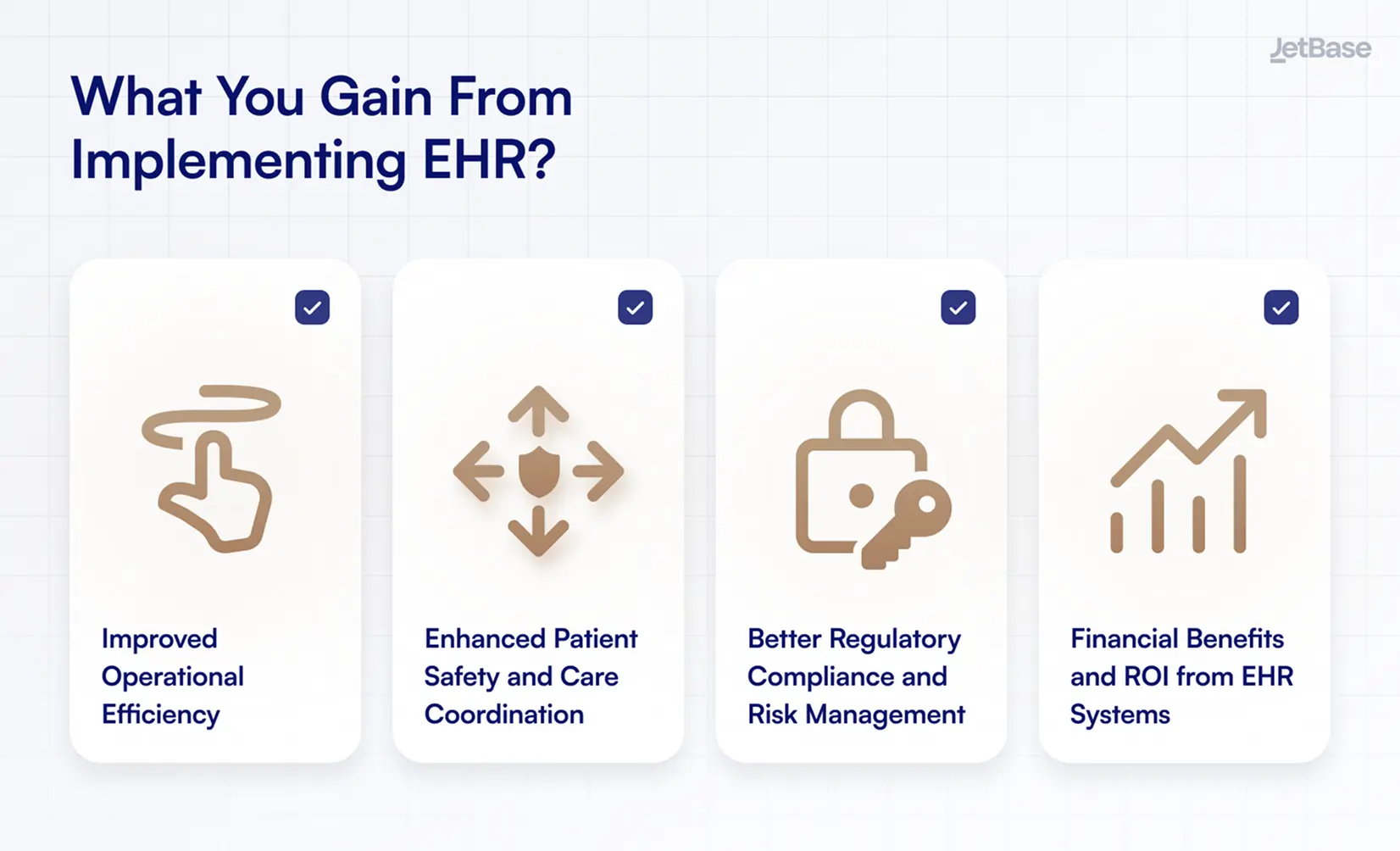
Improved Operational Efficiency
Research proves that medical organization efficiency is influenced not just by staff numbers but also by the application of useful systems, such as EHR. These allow doctors to spend less time on admin work, providing faster care to patients.
Enhanced Patient Safety and Care Coordination
Speed isn’t the only thing that EHR improves, as it helps doctors collaborate and stay fully informed on a patient’s needs, preventing cases of adverse reactions to drugs. Having comprehensive data on patients' medical history is a core boon of EHR systems.
Better Regulatory Compliance and Risk Management
Compliance is part of the cost of EHR, but it’s also one of its benefits, as it helps ensure your data storage and management are all in line with legal regulations. This helps mitigate the typical risks in the healthcare field and avoid malpractice cases.
Financial Benefits and ROI from EHR Systems
Data shows that using EHR systems can help generate as much as $10,000 to $20,000 per bed annually for hospitals. This does require a conscious effort from the organization to utilize EHR data and optimize its workflow. But this kind of return is more than worth it.
How to Compile Your EHR Budget
Here are some useful tips on keeping your budget in check by approaching EHR systems with care.
Choosing Between Cloud-Based vs On-Premise Solutions
Most organizations won’t readily have enough server hardware to support a sprawling EHR system. Therefore, the typical pick, and one that keeps the EHR implementation cost moderate, is to go with a cloud provider. Plus, they come with plentiful resources and easy infrastructure management, two major pluses.
Factoring in Hidden Costs of EHR Implementation
Remember that unforeseen expenses should be baked into your budget, leaving some room for maneuvering. This can include updating your legacy systems to be compatible with this new software, upgrading hardware, or simply working on data transfers.
Understanding the Pricing of Popular EHR Systems
If you decide against developing your own custom EHR system, the two typical price models you can expect are:
- Subscription-based;
- Upfront license purchase.
The former is a simple monthly or yearly payment, but tends to add up over the years, making it a steep long-term option. Meanwhile, an upfront license can be pricey and require annual maintenance payments, but it will likely add up to lower expenses in the long run.
Popular EHR Solutions and Their Pricing Models
Picking between ready-made and custom can be tough, considering the multitude of factors, so here’s a primer on their qualities.
Ready-Made EHR Solutions
Off-the-shelf software typically has the same drawbacks regardless of category. It lacks flexibility, it locks you into working with a specific vendor, and forces you to trust a third party with data security.
Advantages and Costs
When it comes to the EHR implementation cost breakdown, licensed EHR systems do have the advantage of having the cost distributed over an extended period instead of a lump sum. They’re also designed to be as compatible as possible, making adoption easier.
Best for Small to Medium-Sized Practices
What could be both a plus and a minus for ready-made EHR software is that it’s typically designed for simplistic use in standardized conditions. Therefore, it’s suited mostly for smaller businesses, where innovative or complex workflows aren’t common.
Custom EHR Solutions
Requiring a solid investment of both resources and money, custom solutions may not be an option for those on a budget. They do, however, offer the ability to update them as you see fit, use your preferred tech stack, and tightly control data processing.
Tailored Solutions for Larger Organizations
Crucially, you can tweak custom EHR systems almost endlessly to fit the business that pays for them. This includes unique features, tailored integration with proprietary infrastructure, and enhanced security features.
Cost Implications and Long-Term Benefits
With these, the cost of EHR implementation is steep right away, but very transparent and easy to control. You’ll be able to limit the system’s development based on your budget availability and generate some solid ROI by applying a tailored solution that enhances your services.
Calculating the Total Cost of EHR Implementation
Now that we’ve looked at all the details of EHR implementation cost, let’s try to calculate what the final expenses will look like.
Direct vs Indirect Costs
Things like licensing fees or development budgets are pretty obvious direct expenses, but they’re not the whole cost of installing an EHR system. You’ll also need to account for support payments, long-term maintenance, purchasing necessary hardware, etc.
Workforce Costs and Resources Needed
Another major chunk of the cost of EHR implementation is what you’ll spend on the development or maintenance teams. This also combines with the expenses for hardware and storage options, which usually can be curbed by going with cloud hosting, a cheaper approach.
Evaluating the Return on Investment (ROI)
It’s important to understand that you’re not sinking money into nothing, as EHR systems will recoup your investment by optimizing your operations and increasing the quality of services. To calculate what EHR has done for you, gather extensive analytical data and compare the before and after.
Key Challenges and Obstacles in EHR Implementation
Implementing an all-new EHR system doesn’t always go as planned, so let’s finish by discussing the potential roadblocks that you should avoid.
Managing EHR Costs Efficiently
You don’t want to let the EHR implementation cost get out of hand, which can happen with poorly managed development or overly ambitious projects. Draw up a plan and stick to it, fitting the work to your capabilities.
Navigating Regulatory Compliance Requirements
While qualified development teams will typically know how to keep your app compliant with relevant legislation, they might have blind spots for specific regions and features. Therefore, it’s best to recruit a legal consultant if you can fit that into your budget. This will ensure your product is fully in line with regulations.
Overcoming Technological Barriers and Resistance to Change
Data suggests that staff hesitation is one of the barriers to adopting EHR systems, as some professionals might be more accustomed to older tech or unwilling to change from traditional methods. This can be solved by offering training and onboarding lectures to show the advantages of EHR.
Training and Skill Development Challenges
Granted, the training that solves the resistance problem can be tricky in itself. You have to either develop one course that fits all or split it into specialized training plans. This is the better approach as nurses and doctors of different specializations will have varied experiences with the system.
Need Help with Implementing EHR?
This ends our EHR implementation cost breakdown, but our ability to help doesn’t stop there. With over a decade of practical experience in creating custom software and adapting infrastructure to support optimization, JetBase is a leader in software development. We have experience in the medical field, creating sprawling SaaS solutions and flexible platforms.
Working with us means getting top-notch quality, professional communication, and the realization of your ideas. So if you need EHR, you need JetBase, and we’re just a message away.