

AI is transforming the software industry, and AI-powered SaaS has become one of the fastest-growing product categories. Combining artificial intelligence with the scalability of SaaS enables businesses to automate workflows, personalize user experiences, and deliver smarter products. Across industries, AI-powered SaaS helps organizations improve efficiency, streamline operations, and create more valuable customer experiences, making it one of the most promising directions for modern software development.
In today's guide, we'll use JetBase's experience to explain what makes AI and SaaS such a powerful combination and how to successfully integrate AI into your product. We'll walk through the key stages of AI SaaS development, discuss the main cost drivers, and share practical considerations for building a scalable AI-powered platform. By the end of this guide, you'll have a clear understanding of the development process and be better prepared to launch your own AI SaaS product.
So, without further ado, let's explore how to combine AI and SaaS to build products that deliver real business value.
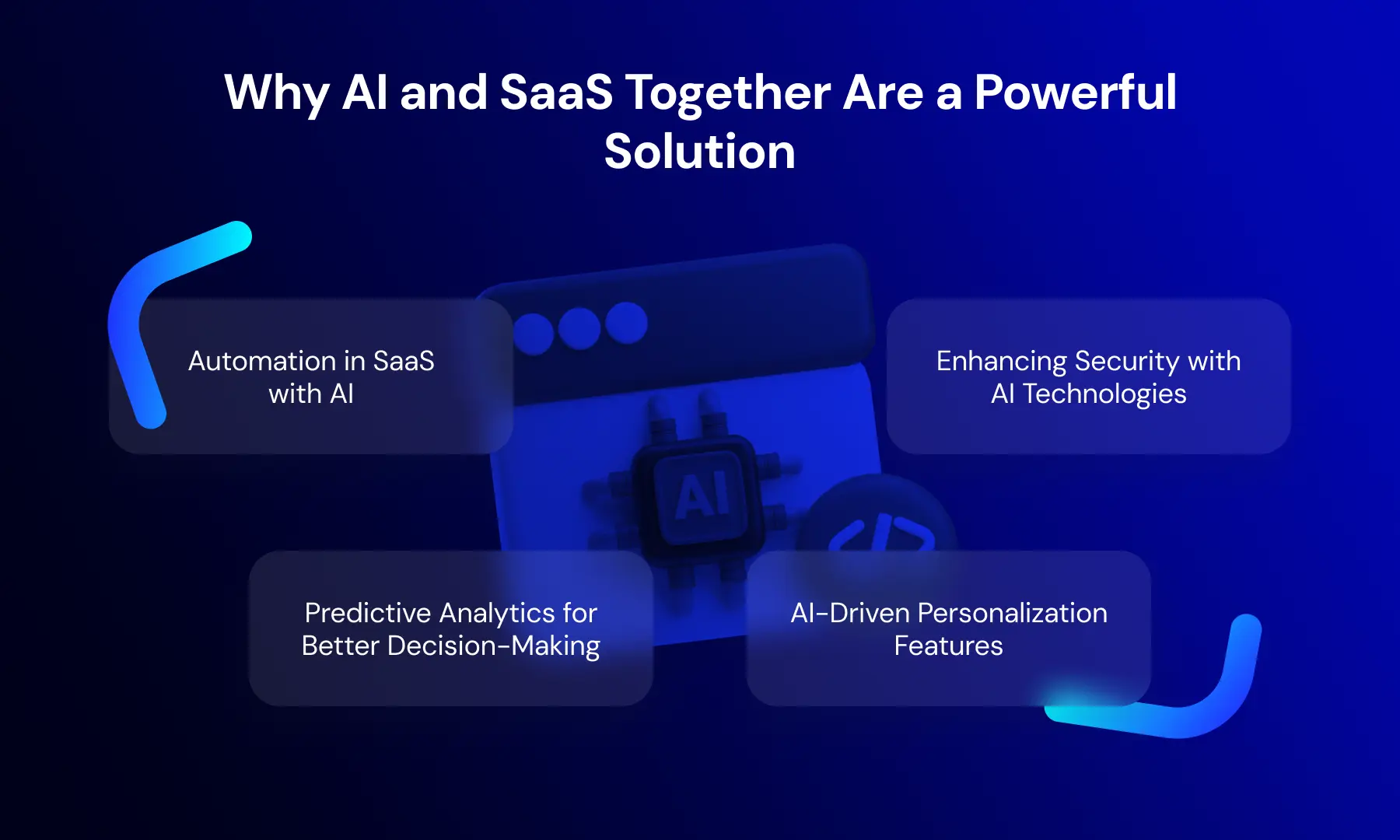
Why AI and SaaS Together Are a Powerful Solution
Interest in AI continues to grow as businesses increasingly adopt AI-powered solutions across products and internal operations. While some may still be wary of investing in this technology, the pairing of AI and SaaS is more than just a passing trend. Here are some of the key reasons why AI-powered SaaS products continue to deliver significant business value.
Automation in SaaS with AI
When automation through AI actually reduces operational costs
AI automation reduces operational costs when it replaces time-consuming, repetitive tasks that normally require skilled employees.
Many operational workflows involve routine activities that slow teams down simply because of their size, complexity, or dependence on employee schedules. AI can handle these tasks instantly and continuously without waiting for working hours.
Some practical examples include:
- AI meeting notes that automatically summarize discussions and extract action points, removing the need for manual note-taking.
- AI assistants analyzing large documents — hundreds of pages can be processed in minutes to find relevant information.
- AI code review assistants that analyze pull requests and highlight issues, allowing senior developers to review only the final version.
- AI personal assistants that track agreements from emails or chats so teams do not miss commitments.
- AI agents supporting junior specialists, answering technical questions without requiring senior engineers to interrupt their work.
- AI-based testing tools that simulate millions of possible scenarios and combinations, dramatically reducing manual QA time.
AI-Driven Personalization Features
Personalization works only if user behavior data exists
AI-driven personalization is effective only when a product collects sufficient behavioral data about its users. Without it, personalization becomes guesswork rather than intelligent adaptation. Even minimal data can provide useful insights. For example:
- 2–3 search queries are often enough to understand a user’s basic intent.
- Browsing history allows the system to identify interests and categorize content preferences.
- Time spent on specific content helps determine what users truly engage with.
- Likes, reactions, or comments allow AI to build a far more accurate user profile.
The more behavioral signals a system collects, the more precisely AI can personalize recommendations, product features, and user journeys. Without this behavioral data, AI personalization cannot produce meaningful results and may even worsen the user experience.
Predictive Analytics for Better Decision-Making
Predictive analytics is valuable only when there is sufficient structured historical data
Predictive analytics is one of the most powerful applications of AI in SaaS, but it only works when enough structured historical data exists. The accuracy of predictions depends heavily on the dataset size.
| Dataset Size | What It Enables |
|---|---|
| 1,000 – 10,000 records | Allows basic forecasting with rough predictions and early pattern detection. |
| 10,000 – 100,000 records | Provides more reliable predictions and enables models to identify meaningful behavioral patterns. |
| 100,000+ records | Supports highly accurate forecasting and advanced decision-support systems. |
Another critical factor is data diversity and time coverage. Ideally, datasets should cover at least 1–2 years of activity so models can capture seasonal patterns and variations in user behavior.
Without structured historical data, predictive analytics cannot deliver reliable insights and often produces misleading forecasts.
Enhancing Security with AI Technologies
AI enhances security in high-volume systems with anomaly detection needs
AI-based security solutions are particularly effective in systems that generate large volumes of activity logs and user interactions. In large platforms, millions of log records may capture user behavior, transactions, and system events. Manually analyzing such volumes is impossible, while AI models can monitor them in real time. Typical use cases include:
- detecting unusual login behavior
- identifying fraud patterns
- monitoring abnormal user activity
- flagging suspicious transactions
AI systems continuously learn from new data and can identify behavioral patterns that resemble fraudulent activity. Once detected, the system can either automatically block suspicious actions or escalate them for manual verification.
For platforms with large user bases, such systems can prevent substantial financial losses by identifying threats early.
When AI Actually Creates Product Value
For AI features to justify their complexity and cost, they should produce measurable improvements in product performance or business outcomes. Some of the most common KPIs that demonstrate real value include:
- Operational costs
AI automation reduces the need for large operational teams and minimizes manual work. - Average Revenue Per User (ARPU)
Personalization increases conversion rates and encourages users to spend more within the product. - Ad revenue per session
AI-driven ad targeting improves click-through rates and advertising revenue. - Customer Lifetime Value (LTV)
AI assistants, automation, and personalization make products more valuable and harder for users to abandon. - Fraud loss reduction
AI anti-fraud systems reduce financial losses caused by fraudulent activity. - Search success rate
AI-enhanced search increases the likelihood that users find relevant results quickly. - Retention rate
Personalized notifications and recommendations encourage users to return, increasing DAU and long-term engagement.
If AI features do not improve at least one of these metrics, their product value should be reconsidered. These are the conditions under which an AI SaaS platform can justify its complexity and deliver measurable business results.
When AI Adds Unnecessary Complexity
Because AI is currently a strong market trend, many companies attempt to add it to their products purely for marketing reasons. However, unnecessary AI integration often leads to higher infrastructure costs, more complex systems, and disappointed users.
Some common red flags include:
AI features without a clear use case
For example, adding AI summarization or prediction where users do not actually need it.
ChatGPT-like assistants in products that do not require conversation interfaces
If users need quick actions rather than dialogue, forcing them to interact through chat may slow them down.
AI that does not generate financial return
AI systems require expensive infrastructure and specialized engineers. If they do not reduce costs or increase revenue, they can significantly increase operational expenses.
In many cases, simpler deterministic solutions can provide the same functionality with far lower complexity.
Before introducing AI into a SaaS product, teams should carefully evaluate whether it solves a real problem or simply follows a trend.
Key Approaches to Integrating AI into SaaS Products
Now that you know why AI-powered SaaS works, let’s start discussing ways to combine the two. We’ll start off by talking about the AI side of things, which has two core approaches. Each has its strengths, so this section will give an overview to help you make the choice.
Foundation Models and AI APIs: A Faster Approach
Using foundation models through AI APIs is often the fastest way to add AI capabilities to a SaaS product. Leading providers such as OpenAI, Anthropic, and Google Gemini offer powerful models that support natural language processing, content generation, data analysis, coding assistance, and conversational AI. Integrating these services typically requires a lower initial investment and significantly reduces development time compared to building and training a custom AI model.
The tradeoff is that API-based solutions provide less control over model behavior, pricing, and future updates. They may also require additional engineering effort to optimize prompts, manage costs, and integrate AI seamlessly into your existing workflows. For many SaaS products, however, foundation models provide the fastest path to delivering production-ready AI features.
Custom AI Development: Building from the Ground Up
On the flip side of pre-builts, we have the approach of creating an AI SaaS platform. This gives you tons of flexibility and the option to customize the solution over time. Thanks to that, you will have a system that fits your products perfectly and keeps up with your growth.
It is, however, slower to start and more expensive as you’ll have to develop it from scratch. Besides, it will likely require hiring outside help unless you have an in-house AI department. Thankfully, you already know who to turn to for that, and JetBase is happy to help.
Custom AI requires a continuous investment in people and infrastructure. A minimum training dataset size is often 1,000–10,000 diverse, high-quality records just to reduce error into a workable range (still potentially 10–20% error early on). Better quality requires larger datasets and multiple improvement cycles.
A Step-by-Step Approach to Creating an AI-Driven SaaS Platform
Building an AI SaaS platform requires more than simply adding intelligent features to an existing product. Successful solutions treat AI as a business tool that must improve measurable outcomes rather than as a technological experiment.
A well-designed solution should directly impact key metrics such as revenue, retention, operational efficiency, or user experience.
The process below outlines practical steps for building an AI SaaS platform, helping teams move from idea validation to scalable implementation while minimizing technical and financial risks.
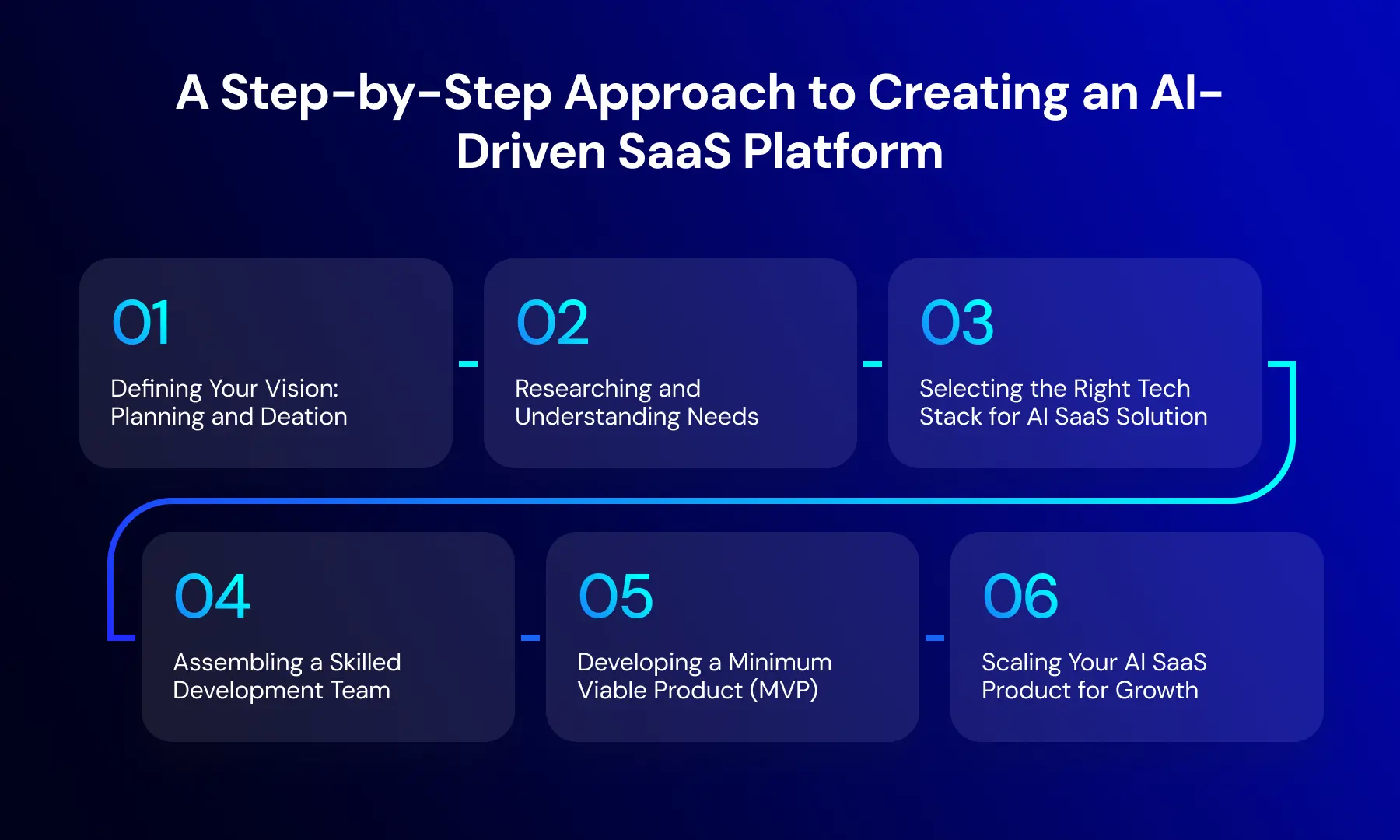
Step 1 – Defining Your Vision: Planning and Ideation
Before development begins, teams must define the business value AI is expected to create. The product vision should describe not an “AI feature,” but a clear AI-driven outcome.
Define Core AI Use Case Before Development
A core AI use case directly influences key business metrics:
- Revenue per user
- Conversion rate
- Churn rate
- Support cost
- Time-to-complete-task
- Fraud loss reduction
- Error rate reduction
- Compliance risk reduction
Teams should then define the task type AI will perform:
- prediction
- classification
- generation
- automation of repetitive workflows
Next, compare baseline performance:
| Approach | Time Required |
|---|---|
| Manual processing | 1 hour |
| Rule-based automation | 10 minutes |
| AI-assisted workflow | 5 minutes |
This comparison helps calculate the measurable benefit of AI.
AI becomes a core product component only when time or cost savings significantly affect business metrics.
Define Success Metrics for AI
AI performance must be measured using both model metrics and business metrics.
| Model Metrics | Business Metrics |
|---|---|
| Accuracy | Time saved per task |
| Precision / Recall | Revenue lift (%) |
| F1 Score | Cost reduction (%) |
| AUC | Retention improvement (%) |
| Hallucination rate | Error reduction (%) |
| Confidence calibration | SLA compliance (%) |
Improving model accuracy alone is not enough. If raising accuracy from 80% to 90% does not change business outcomes, it should not be treated as a primary goal.
Step 2 – The Discovery Phase: Researching and Understanding Needs
This phase validates whether AI implementation is technically and legally feasible.
Define Data Availability Early
AI systems depend heavily on data readiness. Before development, teams must answer:
- Do you have historical data?
- Is the data structured?
- Is it labeled for training?
- Is the data legally usable?
A practical minimum dataset often ranges between 1,000–10,000 diverse records covering real-world scenarios the AI will face.
If data is missing, unstructured, or unusable, preparation may become the most time-consuming stage.
Step 3 – Selecting the Right Tech Stack for Your AI SaaS Solution
Picking the optimal tech stack is crucial, as it determines your platform's performance, scalability, and long-term flexibility. The right technology choices also affect development speed, infrastructure costs, and the ability to integrate AI capabilities as your product evolves. Consult experienced developers to select technologies that align with your business goals without introducing unnecessary complexity or expense.
Modern AI SaaS products are typically built using cloud-native architectures and scalable AI infrastructure. The following technologies are among the most common choices for building secure, high-performance AI SaaS platforms.
| Category | Popular Options |
|---|---|
| Programming Languages | Python, JavaScript (Node.js), C#, Java |
| Frontend | React, Next.js |
| AI Models | OpenAI, Anthropic, Google Gemini |
| Vector Databases | pgvector, Pinecone, Weaviate |
| Databases | PostgreSQL, Redis, MongoDB |
| Infrastructure | AWS, Microsoft Azure, Google Cloud |
| Containers | Docker, Kubernetes |
Step 4 – Assembling a Skilled Development Team
AI SaaS development requires cross-functional expertise.
Minimum Team Structure
| Product Owner | Defines product strategy and ensures alignment with business metrics. |
| Backend Developer | Builds system architecture, integrates APIs, and maintains infrastructure. |
| AI/ML Engineer | Implements AI models, optimizes pipelines, and monitors model performance. |
| Data Engineer (for custom AI) | Prepares datasets, builds pipelines, and ensures data quality. |
This minimal team is sufficient for early-stage AI SaaS development.
Step 5 – Developing a Minimum Viable Product (MVP)
An AI MVP should focus on one core AI capability that solves a meaningful user problem.
What an AI MVP Should Include
- A single high-impact AI function
- Reliable performance on real production data
- Clear improvement of one or more key metrics
What Should Be Excluded
- Complex multi-layer automation
- Advanced personalization systems
- Infrastructure for large-scale traffic
- Features added only for marketing value
Human oversight should remain in critical workflows.
How to Know MVP Is Ready
An AI MVP is ready when:
- Core function works successfully for 10+ beta users
- Success rate reaches 70–80% in real conditions
- Metrics show meaningful improvement
- Error reports are processed within days
- Retention metrics remain stable
- CAC remains lower than LTV
Step 6 – Scaling Your AI SaaS Product for Growth
AI SaaS products require continuous iteration after launch to support both business growth and evolving AI capabilities. As user demand increases, teams need to scale infrastructure, optimize AI workloads, and ensure reliable performance. At the same time, they regularly refine prompts, improve workflows, optimize retrieval pipelines, monitor model performance, and introduce new AI capabilities as models evolve.
Step-by-Step Summary
| Step | Key Focus | Expected Outcome |
|---|---|---|
| Step 1. Vision & Ideation | Define core AI use case and metrics | Clear AI business value |
| Step 2. Discovery | Validate data readiness and legality | Feasible AI foundation |
| Step 3. Tech Stack | Choose APIs vs custom and define architecture | Scalable infrastructure |
| Step 4. Team Setup | Assemble minimal cross-functional team | Efficient development |
| Step 5. AI MVP | Build one core AI capability | Early validation |
| Step 6. Scaling | Optimize costs and monitor models | Sustainable growth |
Understanding the Costs of Developing an AI-Powered SaaS Product
Money may not be everything, but any company knows that sinking too much into development is impractical. So, let’s break down the expenses associated with making an AI SaaS platform and what kind of price level you can expect.
| Aspect | Cost |
|---|---|
| Market Research & Discovery | $8,000 |
| UI/UX Design | $15,000 |
| AI Infrastructure & Model APIs | $10,000–$30,000* |
| AI Development & Integration | $25,000 |
| Application Development | $45,000 |
| QA & Testing | $18,000 |
| Post-launch Maintenance & AI Optimization | $15,000+ |
* Actual costs depend on model usage, infrastructure requirements, and API consumption.
As you can see, the cost isn’t the same for each aspect. While the actual development process is obviously pricey, it’s also the most time-consuming and work-intensive part of creating the platform.
Similarly, training the algorithm is another major cost, which is why we previously mentioned using a pre-built solution. However, remember that this initial investment will pay off later with a more effective AI SaaS platform and the possibility of marketing your own solution.
Factors Affecting the Cost of AI SaaS Product Development
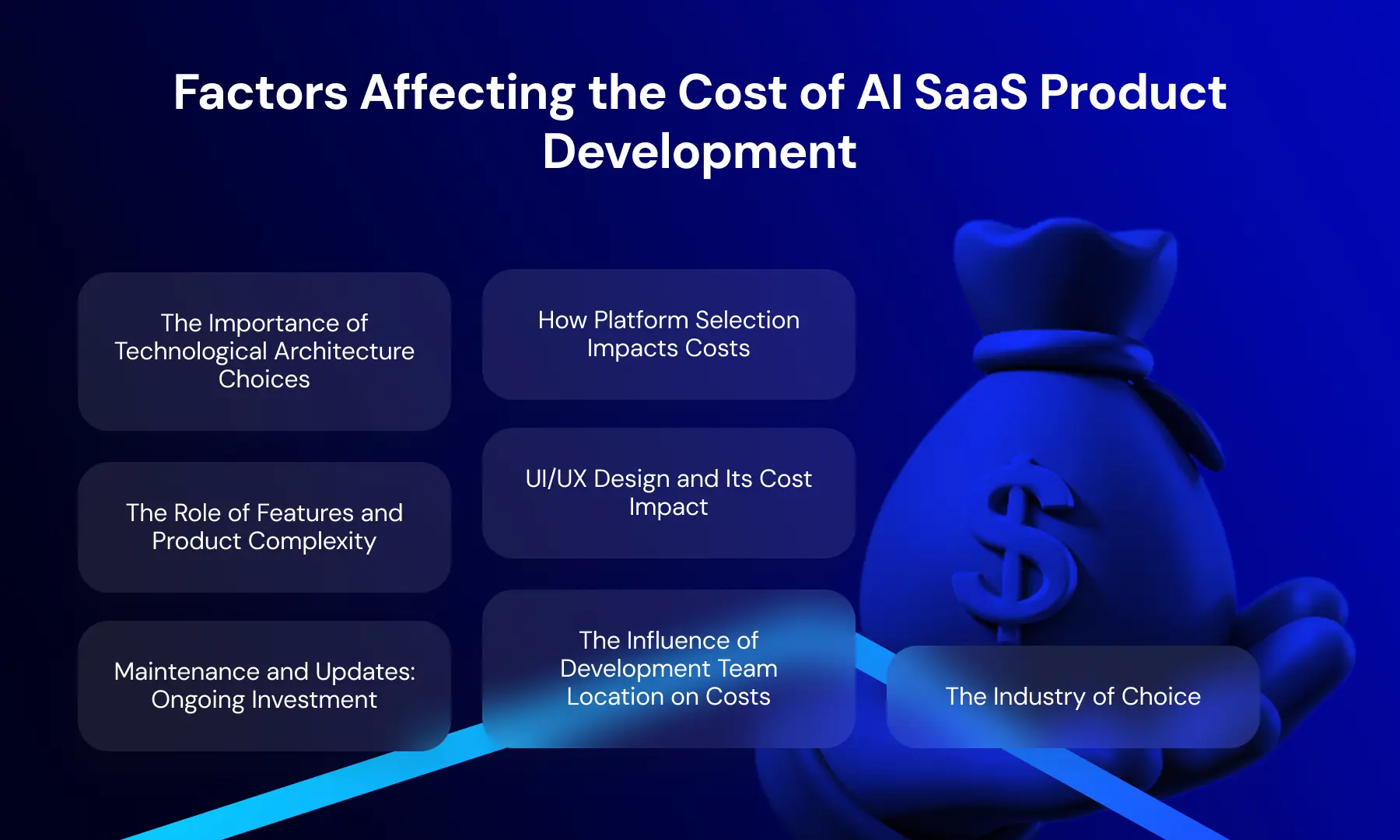
We saw the approximate cost of creating an AI SaaS solution, so let’s discuss some of the factors that shape it. These are all integral parts of the development process and can sometimes be altered to reduce the final cost and make it more palatable.
The Role of Features and Product Complexity
Product complexity is one of the main cost drivers in AI SaaS development. Each additional feature increases development time, infrastructure requirements, and maintenance costs.
Instead of implementing many AI features at once, teams should prioritize the one capability that delivers the highest business value and expand functionality after validating product-market fit. The more AI-driven features you add, the more infrastructure, testing, and monitoring the system will require.
How Platform Selection Impacts Costs
Supporting multiple platforms increases development effort. Building for web, mobile, and desktop simultaneously requires additional development resources, testing, and maintenance.
Many SaaS products start with a single platform, typically web, and expand later once the product gains traction. Each additional platform increases not only development costs but also AI-related processing and maintenance overhead.
The Importance of Technological Architecture Choices
Architecture decisions strongly influence both performance and operational costs. Key factors include:
- cloud infrastructure
- system architecture (monolith vs microservices)
- data storage and processing pipelines
- AI inference strategy (API-based vs custom models)
Well-designed architecture reduces infrastructure overhead and simplifies future scaling. Poor architectural decisions can significantly increase AI inference costs and reduce system performance at scale.
UI/UX Design and Its Cost Impact
Design costs increase when products require multiple design iterations or complex workflows. AI SaaS interfaces often need additional testing because users must understand and trust AI-generated results.
Early user testing helps reduce redesign cycles and improves usability before development progresses too far. AI interfaces often require additional validation and feedback mechanisms to build user trust.
The Industry of Choice
Industry requirements significantly affect development costs. Regulated industries such as healthcare or fintech require additional security, compliance checks, and data protection mechanisms.
These requirements increase development effort but are necessary for legal compliance and user trust. In regulated industries, AI implementation also requires additional compliance, auditing, and data governance layers.
The Influence of Development Team Location on Costs
Development costs vary by region due to differences in engineering salaries. Teams in North America and Western Europe typically have higher rates, while regions such as Eastern Europe offer strong technical expertise with more moderate costs. Choosing an experienced team is usually more important than choosing the lowest rate.
Maintenance and Updates: Ongoing Investment
AI SaaS platforms require continuous maintenance after launch. This includes:
- monitoring model performance
- fixing bugs and improving reliability
- updating AI models as data changes
- maintaining infrastructure and security
Ongoing support ensures the product remains stable and continues delivering value as usage grows. AI systems require continuous monitoring, retraining, and optimization, which makes maintenance a significant long-term cost factor.
Successful AI SaaS Platform Examples to Inspire Your Project
In order to highlight just how transformative AI can be, let’s take a look at some real-world examples of it. These are a couple of companies that gained all-new benefits by integrating artificial intelligence into their business.
Notion: AI for Knowledge Work and Productivity
Notion was already a widely used productivity platform before introducing AI. Since the product revolves around documents, notes, and structured knowledge management, AI capabilities naturally fit into its core workflows.
What problem did AI solve?
Notion users spend significant time reading documentation, writing notes, and searching for information across large knowledge bases. AI was introduced to automate these tasks and reduce manual effort.
Key AI capabilities include:
- summarizing long documents
- extracting action items from meeting notes
- rewriting and improving text
- answering questions based on workspace knowledge
- improving internal knowledge search
These tools increased the speed of information processing and reduced the risk of missing important details.
Why did users adopt the AI feature?
Users adopted Notion AI because it directly improved productivity in everyday workflows. For example:
- long documentation could be analyzed faster
- action items were automatically extracted from meeting notes
- users spent less time searching for relevant information
These improvements reduced routine work and made knowledge management significantly more efficient.
Business impact
AI integration created measurable business results:
- higher ARPU due to upgrades to AI-enabled plans
- improved retention, as users became dependent on productivity gains
- increased LTV driven by long-term adoption
Why this implementation worked
Notion integrated AI directly into existing workflows, such as pages, documents, and databases, instead of introducing a separate chatbot experience. The company also relied on AI APIs, which reduced development costs and enabled faster deployment. Because many AI tasks involve summarization and text assistance, small inaccuracies are acceptable and do not harm the user experience.
Intercom: AI for Customer Support Automation
Intercom is a SaaS platform used by companies to manage customer communication, support workflows, and live chat interactions.
As companies scale, support teams often struggle with increasing volumes of repetitive customer questions. Intercom introduced AI-driven support agents to automate these tasks and improve support efficiency.
What problem did AI solve?
Customer support teams often spend large amounts of time answering repetitive questions and navigating extensive knowledge bases.
AI was introduced to automate tasks such as:
- answering frequently asked questions
- retrieving relevant documentation
- assisting support agents during conversations
- routing requests to the correct team
This allowed companies to handle higher support volumes without proportionally increasing support staff.
Why did users adopt the AI feature?
Companies adopted AI support tools because they improved both response speed and operational efficiency. Customers received faster answers, while support teams were able to focus on complex issues rather than routine requests.
Business impact
AI-driven automation created several measurable benefits:
- reduced support costs
- faster response times
- improved customer satisfaction
Why this implementation worked
Intercom integrated AI directly into its existing messaging workflows instead of creating a separate AI interface. AI assists human support agents rather than replacing them completely. Because the system relies on company knowledge bases and documentation, responses are grounded in structured information, improving reliability.
Summary of AI SaaS Implementations
| Company | AI Use Case | Business Impact |
|---|---|---|
| Notion | AI summarization, knowledge search, and content generation | Increased productivity, higher ARPU and retention |
| Intercom | AI customer support automation | Reduced support costs and faster response times |
Common Challenges in AI SaaS Platform Development
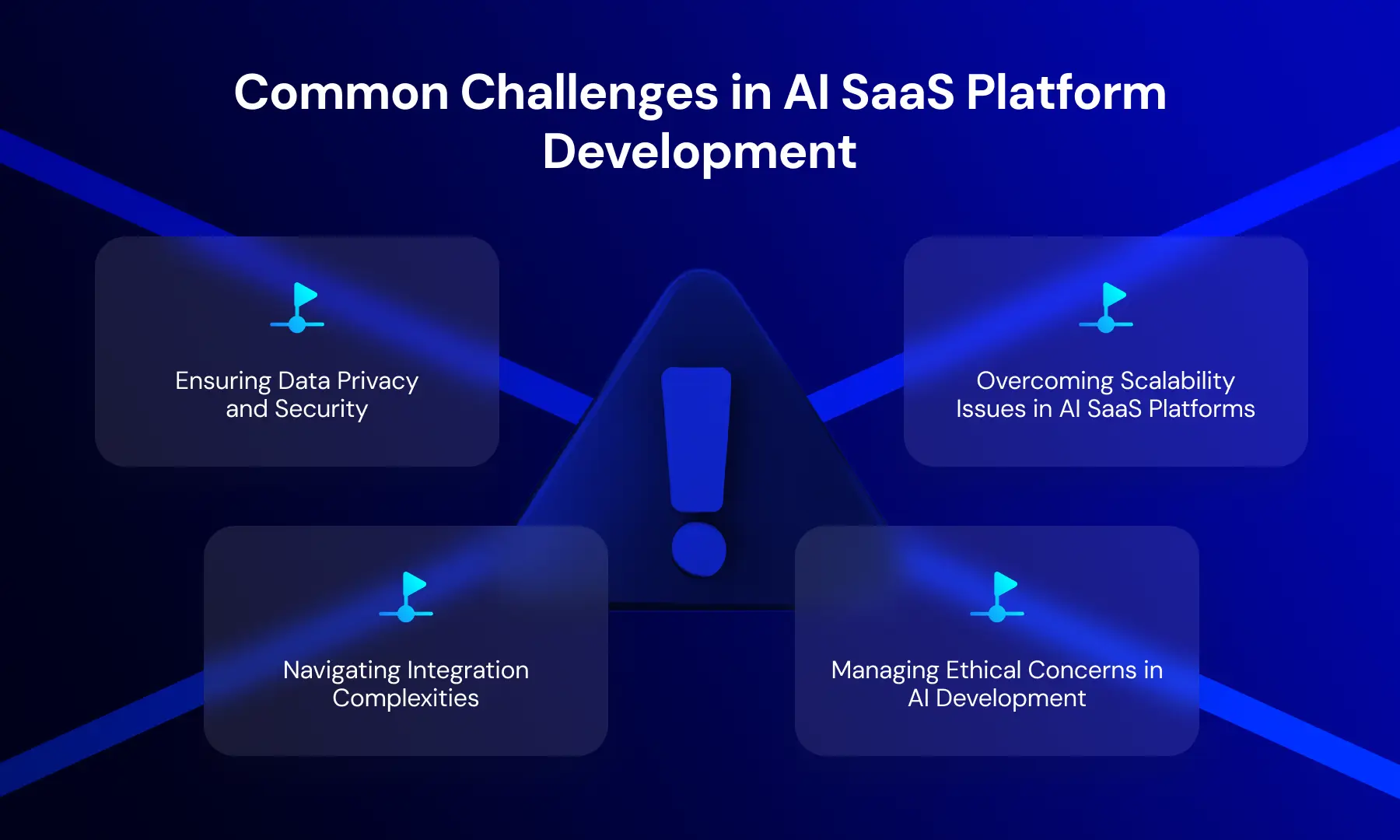
Like any SaaS AI platform, AI-driven products come with a unique set of challenges that affect performance, scalability, cost, and user trust. While none of these challenges are insurmountable, they require careful planning and the right architectural decisions.
Many of these challenges are not obvious at the early stages but become critical as the product scales and real user data is introduced.
Ensuring Data Privacy and Security
AI-powered SaaS products rely on large volumes of data, including sensitive user and business information, which significantly increases security and privacy requirements. While AI can enhance security in certain areas, it also introduces new risk surfaces related to data pipelines, model access, and inference results.
To mitigate these risks, AI SaaS solutions must be designed with security built into the architecture from the start. This includes strong encryption for data at rest and in transit, robust authorization and access controls, and clear separation between training data, models, and production environments. Without proper safeguards, AI systems can unintentionally expose sensitive data or create new attack vectors.
Overcoming Scalability Issues in AI SaaS Platforms
Scalability challenges in AI SaaS platforms often stem from architectural decisions made early in development. As AI features scale, bottlenecks can appear in model inference, data processing pipelines, and infrastructure resources, leading to increased latency and rising operational costs.
To address these risks, AI SaaS solutions should be designed with scalability in mind from the outset. This includes selecting a tech stack that supports horizontal scaling, separating AI workloads from core application logic, and aligning feature complexity with infrastructure capabilities. Without this alignment, ambitious AI functionality can quickly outgrow the platform’s ability to scale efficiently. If not planned early, AI-related bottlenecks can quickly lead to rising costs and degraded user experience.
Navigating Integration Complexities
Integrating AI-powered SaaS solutions into existing business ecosystems often introduces additional complexity, especially when multiple data sources, third-party services, or legacy systems are involved. Common challenges include inconsistent data formats, managing access permissions across systems, and maintaining reliable data flows for AI models.
To reduce integration friction, teams should prioritize clear data ownership, well-defined APIs, and modular system architecture. Addressing integration requirements early helps prevent downstream issues such as data inconsistencies, delayed AI responses, or limited system scalability as the product evolves. Poor integration often results in inconsistent data flows, delayed responses, and unreliable AI outputs.
Managing Ethical Concerns in AI Development
Ethical considerations in AI development go beyond compliance and directly affect user trust and product credibility. AI SaaS solutions often rely on large and diverse datasets, making data sourcing, consent management, and bias mitigation critical design concerns rather than afterthoughts.
To address these challenges, teams should ensure that training data is obtained from verifiable sources with clear user consent, apply transparency to AI-driven interactions, and regularly assess models for bias that could impact outcomes or user experience. Equally important is disclosing the use of AI within the product, allowing users to understand when and how automated systems influence decisions or recommendations. Ignoring ethical considerations can directly impact user trust and long-term product adoption.
The Future of AI SaaS Development: What’s on the Horizon?
The future of AI SaaS platforms is shifting from experimentation to efficiency, reliability, and cost control. As AI adoption grows, companies are focusing less on adding new features and more on building sustainable, scalable products that deliver consistent value.
Growing Focus on Efficiency and Cost Control
One of the biggest changes in AI SaaS development is the growing focus on controlling inference costs. Most AI APIs charge based on token usage, meaning product design directly affects operational expenses. Complex workflows with unnecessary model calls can quickly increase costs at scale.
As a result, many SaaS products are being redesigned to minimize excessive AI usage by:
- simplifying workflows to reduce model calls
- limiting prompt length and context size
- introducing usage quotas in pricing plans
- displaying token or usage indicators to users
Usage limits are becoming a critical part of AI SaaS pricing. When users approach their quota, products often provide clear indicators and upgrade prompts, encouraging them to move to higher plans. Some products also allow users to choose between different AI models, balancing quality, speed, and cost depending on their needs.
AI Embedded in Core Product Logic
Another emerging trend is the shift from AI as an add-on feature to AI being embedded directly into the product’s core functionality. In these products, AI is not just a helper tool — it is the main engine that makes the product valuable. If AI were removed, the product would lose its primary functionality.
Examples include:
- AI writing and knowledge tools
- AI coding assistants
- AI analytics platforms
In these cases, AI becomes the core feature rather than an optional capability, which fundamentally changes how the product is designed and monetized.
Data Governance Becoming Mandatory
As AI systems increasingly process user data, data governance is becoming a central architectural requirement. AI SaaS platforms must carefully manage how data is handled before it is sent to external AI models. Sensitive information should be filtered or anonymized before any model interaction.
Modern architectures often include:
- data sanitization layers before AI processing
- strict multi-tenant isolation between customer datasets
- abstraction layers separating AI interaction from core application logic
Multi-tenant isolation is especially important in SaaS environments. Data from one tenant must never influence model responses for another tenant. These safeguards are becoming essential for maintaining compliance and protecting user trust.
Emerging Trends Shaping AI SaaS Development
Several additional trends are already influencing development decisions:
- Hybrid AI architectures, combining APIs with internal logic
- Retrieval-Augmented Generation (RAG) to improve accuracy using internal datasets
- model monitoring and evaluation systems to track performance over time
- cost-aware AI infrastructure, designed to optimize token usage
At the same time, some AI trends remain overhyped. Simply adding AI features without clear product value often increases system complexity without improving user outcomes. The most successful AI SaaS platforms focus on solving real user problems, improving measurable metrics, and maintaining sustainable operational costs.
Why Choose JetBase for AI SaaS Product Development?
Making an AI SaaS platform from scratch is no easy feat, but the payoff is worth it. It will deliver better customer relations, stronger security, and cutting-edge automation. To reap all of those benefits, though, you need to have a firm grasp of the process. JetBase’s helpful guide gave you the know-how to do it, but another approach eliminates all development risks.
By partnering with JetBase, you get a team of veteran developers who have been creating custom solutions for more than a decade, covering different industries and technologies. We always prioritize producing a polished product that surpasses the client’s expectations. If you want to ensure that your AI-powered SaaS solution beats the competition, you know who to turn to.
If you’re planning to build an AI SaaS platform, we can help you validate the idea, design the architecture, and bring it to production faster.