

The market for custom software development is positively massive, projected to reach $334.49 billion by 2034 as companies delegate the work to external dev teams. However, this traditional model of contract-based hiring isn’t the only way forward. Modern startups and enterprises can utilize software development as a service for flexible collaboration.
Using SDaaS presents a few changes from typical outsourcing, and this guide will teach you all about its pros and cons, giving you an understanding of how this model can help you. By the end of this article, you will be ready to hire your own SDaaS team, so let’s get started.
What Is Software Development as a Service (SDaaS)?
With different technology trends driving the demand for developers, it becomes less and less viable for companies to have an in-house department. As new directions emerge, you have to either re-train your staff or hire more people, with both options ballooning your expenses.
The flipside to this is SDaaS, which is the process of recruiting external devs or entire teams on a monthly “subscription” basis. This is in contrast to the typical per-project hiring, which locks down the team for a specific piece of software. Instead, you have an ongoing agreement to work together, letting you add or remove developers as needed, scaling the work accordingly.
As a whole, software development as a service isn’t reinventing how the industry works. You’re still essentially outsourcing software engineering, just doing it in a way that benefits you more. To understand what makes this model preferable, let’s take a closer look at how it’s structured.
How Software Development as a Service Works
Let’s say you’re a startup that’s planning to launch its own app for client use. With an SDaaS model, you recruit their services and have them build the product or reinforce your own team. Once that’s done, you continue operations as usual and only return to using these external devs when needed, such as when you may want to update the application.
There are some situations where this approach shines the most, such as:
- SaaS companies that require continuous dev support;
- Projects with minimal budgets;
- Enterprises revitalizing their entire ecosystem.
As you can see, SDaaS covers two different extremes - massive projects for big corporations and smaller work for startups. The reason it works so well is the flexibility, which allows the client to determine how and when the developers will be working. You can raise or lower your budget at will, getting only as much as you can afford.
Software Development as a Service vs IT Outsourcing: What’s the Difference?
You might be looking at the guide so far and wondering how this model differs from the more standard outsourcing in practical terms. Well, the core work may be similar, but there are a few factors that set them apart from each other.
The chief difference is the contract, of course, as service software development has you signing up to work with a team on a monthly basis. Conversely, regular outsourcing is usually denoted across the span of one specific project, defined by some tentative deadlines. Once that project ends, you’d have to re-sign the contract, potentially at increased prices or with limited dev availability.
Next, the ability to add or remove team members. Outsourcing companies do let you adjust the team size if it’s absolutely necessary, but it typically involves negotiations and takes some time. On the other hand, SDaaS aims to keep the work flowing with minimal disruptions, easily scaling your team up and down based purely on what you need.
Lastly, the payment scheme. A typical outsourcing provider gets a lump sum in exchange for the work done, while the other option lets you pay as time goes by. Every month, depending on the scale of your projects, you’d pay the involved developers. This should allow companies to assess just how much delegated work they can afford and want to see done.
Which is Best?
As is the case with most answers to “this or that” questions, it depends entirely on your own use case and preference. If you’re running on a tight budget, application development as a service could be perfect. Meanwhile, companies that just need help on a single project will probably not want to sign up for a monthly service when they can just pay once.
So, like we said, simply assess your own needs and resources and make the choice accordingly. In order to make this a bit easier, here’s a table of streamlined comparisons between the two options.
| Factor | Outsourcing | SDaaS |
|---|---|---|
| Contract | Signed on a per-project basis | Subscription model with no set limits |
| Flexibility | Locked into contract, may negotiate changes as needed | Easy to change number of developers and collaboration model |
| Payment model | Based on the contract, negotiated beforehand | Per-month payments, adjusted based on number of devs used and work done |
| Start-up speed | Requires pre-work dev selection and negotiations on the collaboration terms | Quicker vetting with on-the-go condition setting, based on the business situation |
Why Choose Software Development as a Service for Your Business?
Now that we’ve laid out the specifics of SD as a service and how it differs from regular outsourcing, let’s talk about reasons to use it for your own projects. It’s easiest to show off the strength of this model by comparing it to in-house work and typical projects, so let’s do just that.
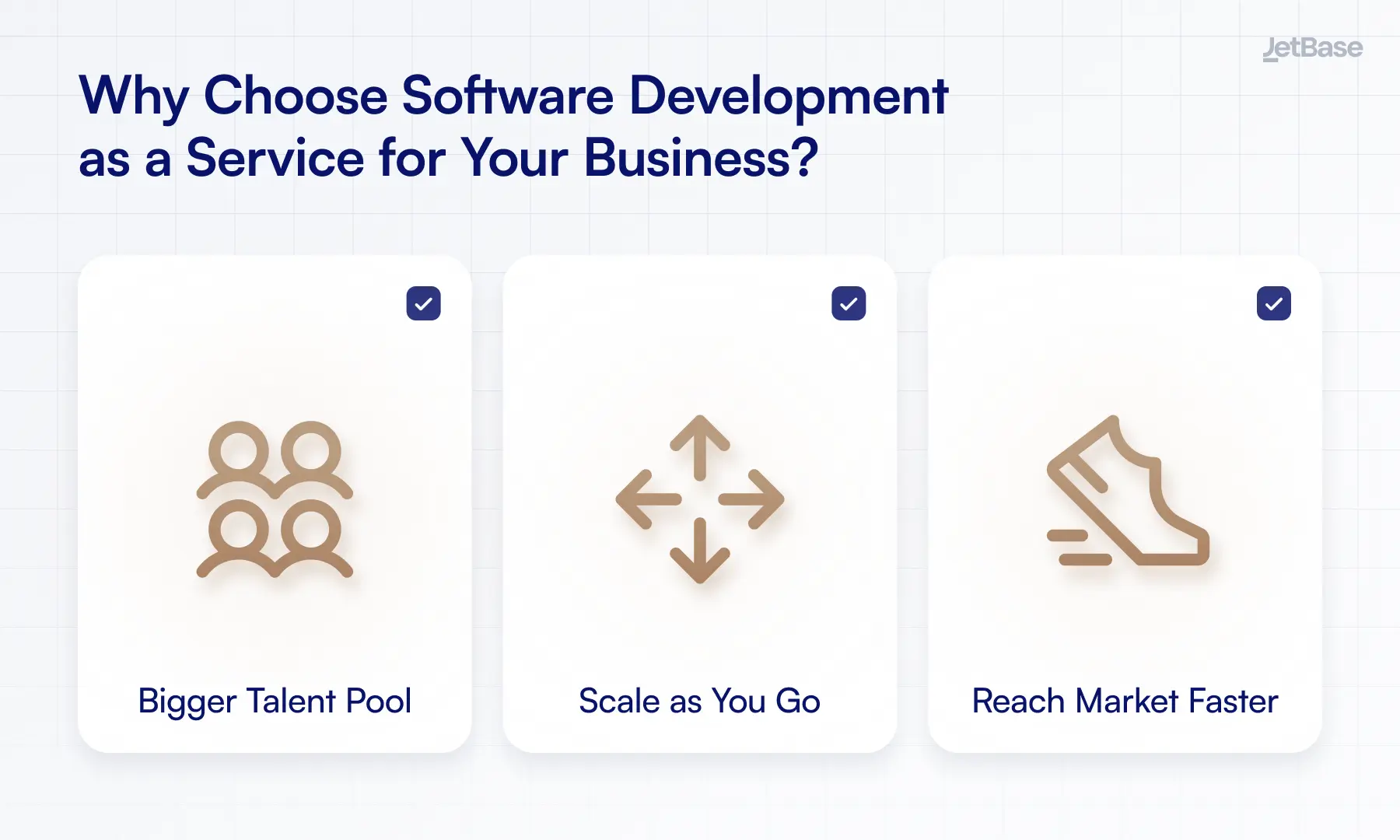
Bigger Talent Pool
No matter how world-class your own team may be, when a new technology like AI or VR takes over the market, you will need to hire new specialists eventually. This becomes much easier to do when you’re working with software engineering as a service.
Specialists rely on this model to get work because they’re not locked into restrictive contracts and can easily find exciting work. Therefore, companies seeking to hire such experts should meet them halfway and use the same model that lets them find the top talent.
Scale as You Go
Some companies may start small but, with luck and hard work, explode in popularity. This kind of success comes with growing pains, as you need to accommodate higher traffic and new duties. Doing so is much easier when you have an array of developers ready to go, which is exactly what SDaaS provides.
You can reduce the number of work hours and team size when the business is in a lull or, conversely, grow it dramatically if you’re experiencing a boom. Whatever direction you’re headed, you can easily move your enterprise along with you.
Reach Market Faster
Instead of headhunting for months, lengthy onboarding, and negotiating contracts, turn to application development as a service. This will allow you to cut weeks or months off of your release schedule, reaching the market quickly and with no compromises on quality.
We’ve already pointed out that you can scale up the team, further accelerating development as engineers can take on different tasks to deliver features faster. Granted, there is a limit to how much this impacts development before the benefits of extra devs plateau, but that’s a high bar to clear.
How Does the SDaaS Process Work?
The collaboration you’ll have with an SDaaS team is quite similar to any other development work, though it is, of course, closest to an outsourcing team-up. Here are some of the steps it takes.
Initial Consultation
You contact an SDaaS representative and introduce them to necessary details such as:
- scope;
- budget;
- deadlines.
This lets them get acquainted with your goals and estimate whether they’re up to the task and can fulfill it within the given parameters.
Proposal
Once that information has been relayed, the representative lays out its vision of how the work will go. Their list can include deliverables, a cost breakdown, and a project plan. If it’s all to your liking, you sign the contract.
Team Assembly
Your provider, with your approval, of course, picks out the right number of specialists, each with their own set of tasks. This is based on their experience and technological knowledge, as well as what your project requires.
Development and QA
The core part of your SDaaS contract, the team gets to work crafting your software and polishing it with multiple rounds of testing. How this goes will be determined by the details of your contract, though what’s important is that the cost of the work will be preset and won’t surprise you along the way.
Deployment and Support
Once your software is ready to go, the same team should help you launch it and provide its services when integrating updates based on user feedback. This can last as long as you’d like, with a monthly contract making it easy to part ways once the work is fully finished. If necessary, you can keep extending the collaboration for years, cooperating with the same team all along.
Disadvantages of Software Development as a Service
Our goal is to present a balanced picture here so that you understand what you’re getting into with SDaaS. That means we now have to talk about the model’s potential shortcomings and illustrate why some companies might struggle with it.
Fully Reliant on Vendor
As is the case with all outsourcing, your project and its progress are completely dependent on the team you collaborate with. Should you decide to part ways in the middle of it, you’d have to completely stop development and wait until you find a new crew to do the work. However, this is only a risk if you’re working with a team that wasn’t properly vetted.
Security Concerns
Entrusting your operational data to another company is always a risk, and you should make sure your SDaaS partner understands that. Ask them how their working environment is secured against outside threats, and prepare extensive NDAs just to cover your bases.
Mismatched Scope
We’ve pointed out above that there is a range of companies and use cases that best fit this model. The flipside to that is choosing to work with an SD as a service team when it’s not a good match could result in unnecessary expenses. For example, if you just need to do some routine maintenance on a project while your team is on vacation, signing a monthly contract is likely pricier than a one-off deal.
When Does Your Business Need Software Development as a Service?
We’ve extolled the virtues of Software Development as a Service and listed some of its potential issues so you hopefully understand its real value. However, just to illustrate our point a bit more, here are our thoughts on what makes SDaaS necessary.
You Need It If…
Look toward SDaaS if your internal team lacks the right specialists, be they designers, engineers, or QA experts. It’s much easier to just get external help than spend months choosing and hiring someone who can be the right permanent fit. Another case where this help could be crucial is a project that’s already somewhat behind and must reach the market quickly. Also, SDaaS might be a good fit if you want to test the waters and assess project feasibility before committing to full-scale development.
Costs in Software Development as a Service Projects
Let’s break down the things that influence your budget for Software Development as a Service:
- Project scope;
- Team size;
- Software complexity;
- Chosen technology.
It’s a pretty clear connection - the bigger and more ambitious your project is, the more it will cost to bring it to life. Such ventures also need extra workforce, so you might hire an extra large team, resulting in more expenses. So always keep in mind the balance between going big and managing your budget. This also applies to the tech stack you use. Not every project needs trendy ones like AI, especially not one that’s supposed to be “budget-friendly.”
How to Choose the Best Software Development as a Service Company
The success of your work with SDaaS hinges pretty much entirely on your choice of vendor. After all, they’re the ones doing the actual development, and their skill and professionalism determine the quality of the final product. So let’s talk about what matters when picking your vendor.
Things to Look For
The core factors for a Software Development as a Service team are the same as for any outsourcing case:
- Prior experience in the industry;
- Verified portfolio;
- Cultural fit;
- Initial impressions;
- Reasonable price point.
We assume the two initial points speak for themselves - a team with no proven experience is not one you want to entrust with important work. As for the cultural fit, it may be less critical, but knowing these engineers will mesh well with your staff and company values can be key. After all, their product will be representing you in the end.
It’s also a good idea to trust your instincts and, if the initial consultation doesn’t go smoothly, there’s no shame in exploring your options further. Also, take note of how the stated rate of your vendor matches up against the market average. If it’s too low, something’s likely off because a good team might try to undercut the competition, but never by a huge margin.
Is SDaaS Right for Your Business in 2025?
We wouldn’t call Software Development as a Service a perfect solution that everyone needs right now. It’s pretty much an evolution of traditional outsourcing and, therefore, will best suit companies seeking those kinds of services. However, if you do find yourself with a limited team or tight budget and want to ensure your project succeeds, using SD as a service is a great idea.
This model will work perfectly as long as you’re teamed up with an expert vendor, such as JetBase. With 10+ years of experience in the market and a whole array of seasoned developers at our disposal, we can help your project succeed. Our diligent work ethic guarantees speedy delivery, high overall quality, and professional communication.
So if you’re ready to start your SDaaS journey, send us a message.