

Companies keep adopting the cloud, with 42.5% of EU businesses purchasing cloud services in 2023. The healthcare sector is no exception to this, as the cloud has the potential to generate immense value for medical institutions. However, cloud migration in healthcare can be tough without external help.
That’s why today’s guide will introduce the benefits and roadblocks of healthcare cloud migration, as well as help you build a strategy to do migration right. Using JetBase’s extensive experience with medical and cloud solutions, we’ll give you an insider’s look at the process.
What Is Cloud Migration in Healthcare?
We’ll start with the basics, introducing the point of migration and the reason for its steadily climbing popularity.
Definition and Core Concept
Cloud migration in healthcare is moving a medical enterprise, along with its data and operations, to a cloud environment, such as AWS or Azure. This way, you put the maintenance and resource allocation responsibility on a cloud provider instead of handling it yourself. It’s a major shift in infrastructure, but it comes with many benefits, which we’ll list below.
Why Cloud Adoption Is Gaining Momentum in Healthcare
Well, like we just said, the process comes with a healthy list of advantages. The chief among them is probably the fact that the cloud allows for better growth. Modern medicine relies heavily on technology and data streams to coordinate and streamline healthcare. Healthcare cloud migration is the logical result of that, as it offers easy synchronization and connectivity.
Main Advantages of Migrating Healthcare Systems to the Cloud
We’ve talked up cloud migration a bit already, but it’s for a good reason. Moving your business to the cloud can bring the following pros:
- Boosted data accessibility
- Minimized expenses
- Powerful security
- Easier scaling
- Streamlined AI adoption
- Better recovery protocols
Enhanced Data Accessibility and Collaboration
Hospitals must collaborate to ensure that patient data is easy to find and process, streamlining registration and healthcare. By opting for healthcare cloud migration, hospitals can make it easier for different branches and partner institutions to collaborate on patient care.
Cost Efficiency and Reduced Infrastructure Expenses
Moving to the cloud means no longer paying for the upkeep and management of on-premise servers. Sure, you’ll still have expenses when you pay the cloud provider, but they tend to be much lower. Not to mention that they will handle all the maintenance work, so you eliminate that expense completely.
Improved Data Security and Compliance with Regulations
While data won’t be stored on servers to which you have physical access, it will be just as secure, if not more so. Working with a major cloud provider on your healthcare cloud migration means getting all of their resources, including their security measures. Giants like Amazon and Microsoft have excellent breach protection and ensure that any data storage is legally compliant.
Scalability and Storage Expansion Opportunities
Building up your infrastructure to support growth isn’t cheap, but a cloud provider comes with enough resources to scale as far as you’d like. Those willing to pay for higher service tiers can enjoy plentiful storage and expand their system as they see fit without concerns about load resistance.
Leveraging Big Data and AI for Advanced Analytics
Another advantage of healthcare cloud migration is that its major resource availability can be used to train AI and gather analytical insights about your business. Using the powerful cloud architecture, healthcare companies can build AI-powered pipelines where data is:
- Received
- Processed
- Analyzed
- Visualized
It results in nearly instant knowledge gain and an ability to understand patients’ needs and preferences better.
Strengthened Disaster Recovery and Backup Solutions
Cloud providers will have extensive backup plans to ensure that customer data is not affected in the very unlikely event of database corruption or other accidents. You will be able to recover from any kind of data loss and revert to intact databases quickly and efficiently.
Step-by-Step Process of Cloud Migration in Healthcare
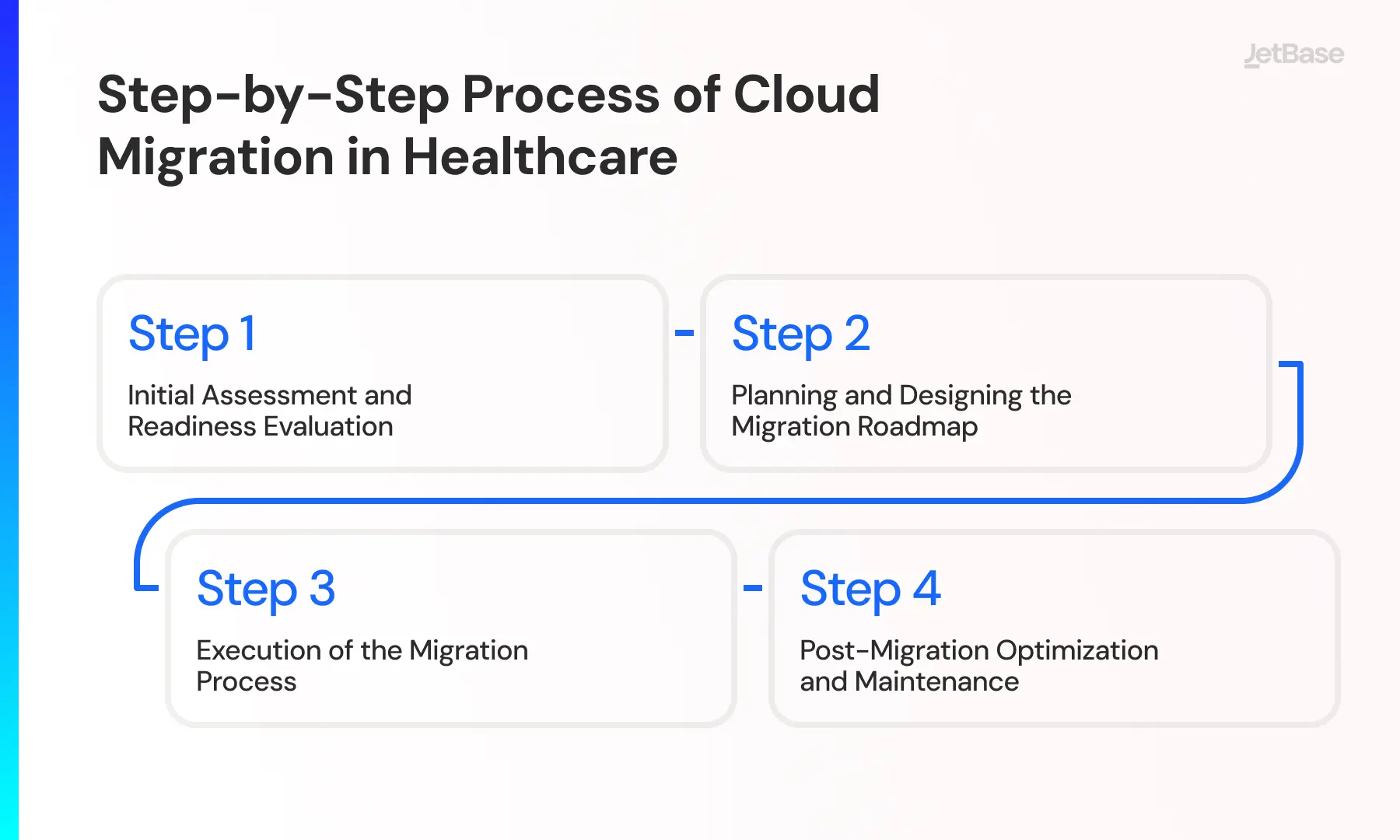
Tackling migration is easier when you do two things. First is hiring a company to help you with the technical side of things. Second, though, is learning exactly what the process involves in stages. Let’s explore that so you can understand what migration will be like for you.
Initial Assessment and Readiness Evaluation
The start of your healthcare cloud migration should be from a critical point of view. Estimate whether you truly need this and if your system is prepared for this move. While the cloud is a chance to retool your structure, the whole process will be easier if it’s already well-organized. Otherwise, you run the risk of extra expenses and getting bogged down with unnecessary work.
Planning and Designing the Migration Roadmap
A detailed plan is vital to keeping the process on track. Lay out your deadlines, the flow of the migration, and its priorities. This will allow your team, whether external or internal, to prioritize the most important aspects and minimize operational downtime. That way, your cloud migration will be “painless,” and you can hit the ground running with your provider.
Execution of the Migration Process
Once the plan is set, you can start the healthcare cloud migration using your team or relying on external help. Make sure to have backups for everything in place because you only get the convenience of provider-controlled ones after the migration is complete. Plus, you should ideally have all of your processes available even during migration to minimize downtime.
Post-Migration Optimization and Maintenance
After you’ve finished healthcare cloud migration, take some time to assess how well your system performs and see what can be fine-tuned about it. The sooner you know what changes should be made, the easier they’ll be to implement. Plus, you should have a team assigned to post-migration maintenance, guaranteeing that you’re always maximizing the cloud’s advantages.
Cloud Solutions and Deployment Models Suitable for Healthcare
Same as in any other industry, healthcare businesses can choose between three typical cloud models:
- Public
- Private
- Hybrid
Each of these comes with its own advantages and drawbacks, so we’ll take a closer look to ensure you’re making the right choice for your healthcare cloud migration.
Public
Going for a public cloud is a likely outcome of any healthcare cloud migration, as that’s what third-party providers offer - from AWS to GCP. It’s a cloud that’s shared between many clients with everyone using the same hardware, resources, and storage opportunities. This has advantages like lower cost, the ability to push tech work onto the provider, and excellent reliability.
Private
Some companies, particularly those that deal with highly sensitive data and run extra complex networks, may build their own private cloud environment. Its pros are pretty clear - easier to set up just the way you want, full control over the data, and no butting heads for resources. However, it’s also more costly and requires a lot of technical know-how to launch and run.
Hybrid Cloud
A hybrid approach to healthcare cloud migration splits your ecosystem into two parts. The first is a typical public cloud, which gives you all of its associated advantages. The second is either an on-premise system or a private cloud that you keep connected to the public one. Choosing this approach can be helpful to:
- Meet regulatory limitations
- Keep control over specific aspects of your operations
- Retain more flexibility
However, it does have the cons of an on-premises approach: you have to do maintenance yourself, spend extra on the hardware, and manage storage and resource use.
Choosing the Right Model Based on Healthcare Needs
Realistically speaking, each of these models has strong merits and could work well for a healthcare business, depending on its specialization and scope of operations. However, if we had to pick one, hybrid is probably the most reliable bet. You get to navigate legal compliance more easily, have full control of patient data and its security, and can scale as needed. While it may be challenging to deal with the technical parts of it, JetBase can help you with that.
Proven Strategies for Successful Healthcare Cloud Migration
Aside from partnering with a skilled team, you can do a few things to make your migration process smoother. These are the top three to know about in our opinion.
Incremental vs. Full Migration Approaches
Your migration is up to you and if planned right, you can take things slow and only move parts of your system over to the cloud instead of going all in. The benefit here is that you get to see how the migration pans out, assess its benefits, and make sure there are no errors in the process.
On the flip side, if you need to move fast and reinvent your system, that can also be done. The benefit of that is seeing how everything functions together and having a clear understanding of which parts may need tweaking in the future. Plus, it’ll help you cut expenses right away if you’re migrating with a plan to minimize costs.
Partnering with Experienced Cloud Providers
We’ve talked about the private cloud option for healthcare cloud migration and why it may be lucrative, but the public one has plenty of advantages, too. One of its hidden strengths is that you’d be working with companies that have spent a long time providing these services.
They know exactly how to maintain the cloud, keep its uptime close to 100%, and get results. So, when you migrate, take a close look at options like AWS, Azure, and GCP, as you may just see the perfect vendor for you.
Ensuring Compliance with HIPAA and Other Healthcare Standards
While big public clouds typically know how to handle compliance, if your healthcare cloud migration is headed the private or hybrid way, you’ll need to plan ahead. Consult current legislation and ensure your data storage and processing meets it fully.
Sometimes, that may mean giving patients view and edit access, other times, it’s about how your database is structured. It’s possible that you may want to consult with a legal expert or a tech team that’s handled compliance issues before.
Common Challenges and How to Overcome Them with Jetbase
Not everyone will have a perfectly smooth experience with their healthcare cloud migration. This section will help make sure you’re prepared for any potential complications or hang-ups that businesses tend to face.
Data Privacy and Security Concerns
Opting to migrate to a third-party cloud means handing over your data to a proprietary cloud that’s no longer under your direct oversight. This is a particularly pressing issue in the medical field, where legislation such as HIPAA protects patient information. In order to stay compliant and secure your medical data, we’d apply strong encryption at rest and in transit, as well as role-based access to it.
Managing Organizational Change and Staff Training
Any change in interfaces, interactions, and procedures will require extensive onboarding to ensure that every employee understands the new system. This helps prevent data logging errors, eliminates the risk of unauthorized access, and speeds up the adoption of this new system created by healthcare cloud migration.
While you can address this by yourself with scheduled staff training, it’s also possible to request a compiled manual on the new infrastructure from your migration vendor. That way, you will have proper documentation that employees can consult for any questions they have.
Addressing Technical Expertise Gaps
Oftentimes, healthcare cloud migration creates the need to rework some tools and change the way maintenance is done within your ecosystem. This can be challenging to staff that has only ever worked with the on-premise system. In this case, it’s a good idea to request post-migration support from your vendor, something that JetBase readily offers.
Maintaining Control Over Sensitive Data
We’ve already mentioned the need to apply quality encryption and role-based access, but you can also negotiate the terms of your sensitive data’s storage with your provider. It’s possible to stipulate that you require full control over viewing and editing of this information. Plus, you can establish a pipeline that creates easy ways to manage and delete the data if necessary.
Cloud Migration in Healthcare with Jetbase
We’ve provided a solid theoretical base for you to move your healthcare business to the cloud, all while preserving data security and operational efficiency. However, JetBase is always ready to go beyond the basics, and we can lend a hand with your healthcare cloud migration.
Our decade-plus in the market has left us with a strong portfolio, including medical cloud solutions, and a team that hones its skills with each passing day. We deliver top-notch quality by listening to our clients’ wishes and providing input based on our own experience. So, if you want your cloud migration in healthcare to be done right, contact us today.