

It’s been said before that Amazon is, essentially, the foundation of our internet, even when you account for its competitors like Microsoft and Google. That statement rings true in 2025, when AWS makes up around 30% of the cloud provider market. However, that’s not all the company's successes, as it also offers unique value to a specific industry with AWS for Healthcare.
This suite of tools for the medical industry was rolled out in 2021 and has been a game changer. It gives the healthcare industry all the resources and scalability that AWS can bring, offering unique chances for medical ideas to thrive and grow. However, even aside from this new direction, AWS has the power to drive healthcare innovation.
Today, we will discuss how to apply AWS in healthcare, using its diverse set of tools and maximizing efficiency through cloud services. Come see through the eyes of experienced developers from JetBase and learn all we know.
AWS Impact on Healthcare: A Data-Driven Overview
With a projected growth to $170.82 billion, the healthcare cloud computing market is clearly poised to be a major success story. Thanks to that, they have more than enough opportunities to help healthcare businesses.
For example, in recent years, there have been a few wonderful examples of AWS helping medical institutions, such as their partnership with the Memorial Sloan Kettering Cancer Center. This endeavor uses Amazon’s advanced AI and cloud infrastructure to speed up cancer research.
What’s great is that mixing AWS and healthcare is proven to work, with research reflecting a staggering 82% efficiency improvement for companies adopting SAP Enterprise Database systems on AWS between 2020 and 2023. This kind of increase indicates that AWS healthcare solutions are the perfect way to collaborate and get results that impact patients’ lives.
At the moment, AWS and AI are pretty firmly coupled, as Amazon is investing heavily in this technology. The same paper mentions that AI integration makes a 73.5% improvement in clinical accuracy possible, marking yet another vital use case for AWS tools.
Another vital point in AWS’s favor comes from research into using their cloud for remote patient monitoring. This practice can potentially spread the services of hospitals to much broader areas while keeping per-patient costs down. However, the paper notes that using the cloud typically presents data access and security challenges. Thankfully, it points out that AWS avoids this issue by investing heavily in privacy protocols and securing its cloud tightly.
All in all, it seems pretty clear that using AWS both as a cloud service and as an AI-forward suite of solutions can be a game changer for healthcare. In fact, for some businesses, it already is. So, let’s talk about whether it’s also the right pick for you and how you can get started with AWS for healthcare.
Why Choose AWS for Healthcare?
If the above data hasn’t swayed you, let’s get down to a close-up level and talk about how AWS can impact separate businesses instead of the industry as a whole. After all, we’re approaching this from the perspective of a company choosing the right tool for the job. So, here is why we would call AWS a beneficial pick for any healthcare business seeking improvements.
Cost Optimization with AWS for Healthcare Software
One of the more pressing questions for any company is expenses, because no matter how well your business runs, it can’t last long when the cost outweighs the income. Thankfully, it’s entirely possible to cut into those costs using Amazon Web Services healthcare solutions.
For example, using the AWS cloud to store and process patient data will reduce your expenses for on-premises hardware and the cost of monitoring, as we’ve pointed out above. Then there’s the fact that using cloud architecture can make maintenance less expensive, reducing years-long costs.
Lastly, AWS can help you limit resource usage, capping the expenses on that front at acceptable levels. Matching these precisely to your needs means no excess costs and better operational organization.
Maximizing Your Data with AWS Solutions
Making your data work for you is an important cost-cutting measure as well as a way to gain better insight into your processes. In healthcare, it can also mean servicing patients better and making well-informed decisions that result in favorable medical outcomes. So, how to maximize the value you get from your data? Well, you can use the following AWS healthcare solutions:
- EC2
- S3
- Kinesis
- Glue
- SageMaker
While some of these, such as EC2 and S3, are well-known and don’t require much explanation, others are a bit less popular yet just as useful. For example, Kinesis is indispensable for lightning-fast data processing for analytics. Another AWS healthcare must-have is Glue, which pairs nicely with Kinesis by handling the ETL part of data analytics. It pre-processes data to get it ready for analysis.
Lastly, SageMaker is Amazon’s custom tool for machine learning. It scales well, covers the entire process lifecycle, and enables healthcare companies to train their own algorithms. In the right hands, this could lead to medical breakthroughs and in-depth processing of patient data, directly improving hospital services.
Data Management and Advanced Analytics Capabilities
With tools like CloudFront and RDS, you can easily manage your vast databases and synchronize data streams. Whether you want to set up efficient processing or just ensure your storage is secure, cost-effective, and easy to work with, there are ways to do just that with AWS for healthcare.
For example, RDS specifically guarantees your data is safe even in the case of corruption or crashes, automatically creating backups and monitoring the database. It also provides encryption to protect the data while isolating it to make sure breaches are unlikely. Plus, the isolation means not all data will be affected should one occur.
Then, of course, CloudFront is vital for fast data delivery, enabling inter-branch connectivity, regardless of location or their own setup. Thanks to that, you can coordinate work and data sharing quickly and effortlessly, owing to just a couple of AWS healthcare solutions.
Key Healthcare IT Solutions on AWS
In addition to general improvements that AWS can offer for your business, we mentioned a set of specialized instruments that it targets in the medical industry. As you may guess, these can be transformative for research and patient processing. Let’s talk about what these tools are and how they can be best applied for maximum results.
Artificial Intelligence in Healthcare
This section alone could constitute a whole article, as Amazon’s big AI push already bears fruit. One such AI-enabled tool is HealthScribe, which is specifically designed to transcribe doctor-patient conversations, allowing for easy record-keeping. It’s a secure way to automate note-taking, which applies generative AI for a good purpose.
Then there’s Amazon Comprehend Medical, which uses NLP methods to identify relevant parts in medical texts, analyze and structure them. This allows healthcare businesses to process tons of data in a heartbeat, such as:
- Prescriptions
- Medical histories
- Diagnoses
- Doctor’s notes
In fact, these AWS healthcare solutions tie into our next section quite neatly and can be combined with other tools for a more effective suite. Let us tell you how to do just that.
Electronic Health Records (EHR) Management on AWS
Amazon itself provides an excellent breakdown of building a record-management strategy using only AWS tools. We’ll save you the click and simply note the most exciting tools in that selection. Our top pick would be HealthLake - an all-in-one data storage and transformation instrument that makes record management a breeze with no risk.
The company does suggest using AI-enabled tools as well, as Amazon Comprehend Medical can obviously be a big help in entering data and digitizing old records. Plus, HealthScribe can keep the records up-to-date with the latest summaries of doctor visits.
As you can see, AWS healthcare tools synergize beautifully, which creates a reliable, secure ecosystem that addresses typical medical company needs. But that’s not all, as there are also instruments that help with vital areas such as imaging and genome research.
Medical Imaging with AWS Technology
Imaging makes up a big part of medical processes that healthcare organizations deal with daily. The resulting data has all the typical requirements that other medical info does. It needs to be processed accurately, stored safely (and compliant with HIPAA), and shared with relevant parties.
Doing all that is quite simple with HealthImaging, Amazon’s specially designed tool for imaging data. Its functions range from straightforward storage and sharing features to more forward-thinking things like AI-based analytics for images. It also offers to merge your data with other AWS healthcare tools - HealthLake and HealthOmics - to analyze it more precisely.
Keeping the data in the AWS ecosystem while applying modern processing techniques is a big plus, and Amazon knows it. It encourages healthcare companies to use their tools in ways that improve accuracy and analytical precision.
Clinical Genomics Powered by AWS
Last on our list but no less useful than the rest is AWS HealthOmics. We’ve mentioned it just now, but it deserves a section of its own as it’s the prime tool for medical researchers. HealthOmics pushes medicine forward by efficiently storing and processing literal petabytes of research data, using AI to clean it up, analyze it, and draw conclusions.
With this AWS for Healthcare tool, you can expect to substantially speed up any research and make collaborative efforts easier. It offers a secure and user-friendly sandbox to work with medical data and, combined with other AWS instruments, can be a vitality shot for new discoveries.
AWS and Financial Optimization in Healthcare
Aside from being a way to cut expenses, AWS tools can structure your company’s financial matters and optimize those processes. Let’s take a look at two core examples.
Streamlining Enterprise Resource Planning (ERP) with AWS
There are a variety of AWS healthcare solutions that support better ERP practices and results. This includes general-purpose things such as EC2, which allows for more secure ERP solutions that can scale faster. But there are less popular options such as Athena and Redshift, perfect for data analysis and gaining deeper insights.
You can also, of course, use external ERP solutions and host them on AWS to optimize their performance and integrate them with the rest of your AWS-based ecosystem. It’s a simple approach but no less effective at keeping your financial operations moving fast.
Revenue and Claims Management via AWS Solutions
Another possible application of AWS for healthcare is to use Amazon’s advanced AI tools to speed up billing and claim management. You don’t have to go all in and completely automate the process. Yet, AI models can do things like filter out the most relevant claims. This way, your employees will spend less time per claim, processing essentials and easily spotting ones that are more likely to be simply rejected.
Plus, you can set up simple templates that speed up the entire claim cycle and minimize the chance of error. This is a major boon for hospitals and insurance companies that deal with a huge caseload, which is impossible to effectively sort through manually.
AWS Initiatives in Healthcare
It’s not uncommon to hear of support from AWS for healthcare initiatives, such as this $20 million initiative. That’s already good, but it comes on top of another $40 million. Then there’s a list of companies that AWS specifically partners with to boost their research and innovation efforts.
By putting this effort into bolstering the healthcare field, AWS helps move medicine forward and creates a working relationship with promising companies. Its billion-dollar investments show just how much effort goes into ensuring that the future of medicine lies in AWS.
AWS Security and Compliance in Healthcare
It’s impossible to talk about any sort of software development in the medical field without touching the two main challenges that it faces: regulatory compliance and data security. We have pointed out above that AWS is no slouch when it comes to these, but let’s talk a bit more about how it handles them.
How AWS Stays Compliant and Secure
The basic approach of AWS healthcare solutions to security is the same one you always expect:
- Encryption for all data
- Support for MFA
- Extensive monitoring tools
But in addition to these, users are also encouraged to use tools like Amazon Macie for data management. This one helps identify and protect specific data categories that are considered sensitive. Such tools obviously work best when your entire setup relies on AWS, making them easier to integrate.
As for compliance, all AWS healthcare solutions are obviously designed to be compliant with all medical regulations. You can expect that any work you do with them will be HIPAA-friendly and secure, with no need for extra effort on your part. That’s one of the big advantages of using AWS, as the substantial resources behind it make it fully tailored to the medical industry’s needs.
Benefits of Going Serverless in Healthcare Solutions
![Cloud Software Development [AWS].webp](/static/Cloud_Software_Development_AWS_a351611d38.webp)
AWS fully supports the serverless approach, but just because the opportunity is there doesn’t mean you have to use it. Let’s talk about why going serverless is popular and whether its advantages are worth it for your use case.
Scale with Attractive Rates
Working with AWS healthcare solutions means needing a lot of resources and throughput ability, both of which the serverless method offers. Apps built with this approach will scale automatically while working on a pay-per-use model that limits your spending. Increasing the number of users and the size of your database at will can make growth painless.
Besides, it’s important to note that AWS infrastructure is resilient, and you will have constant uptime with all the resources available whenever you need them. This doesn’t change when going serverless, leaving it a viable option even for critically important apps that need 100% uptime.
No Server Management, Quicker Integration
Using AWS in healthcare is often the result of wanting to build a sprawling ecosystem where each element serves to improve the app and optimize its performance. Serverless takes this to the next level, offering built-in integrations to Amazon services. You won’t have to do any extra work to get your application rooted in the AWS ecosystem.
Plus, you won’t be spending time or money on server management and maintenance. Things like patching the environment or working on capacity availability will be left behind entirely. Thanks to that, you can focus on the app and its performance instead of busywork.
Steps to Implement AWS Healthcare Solutions
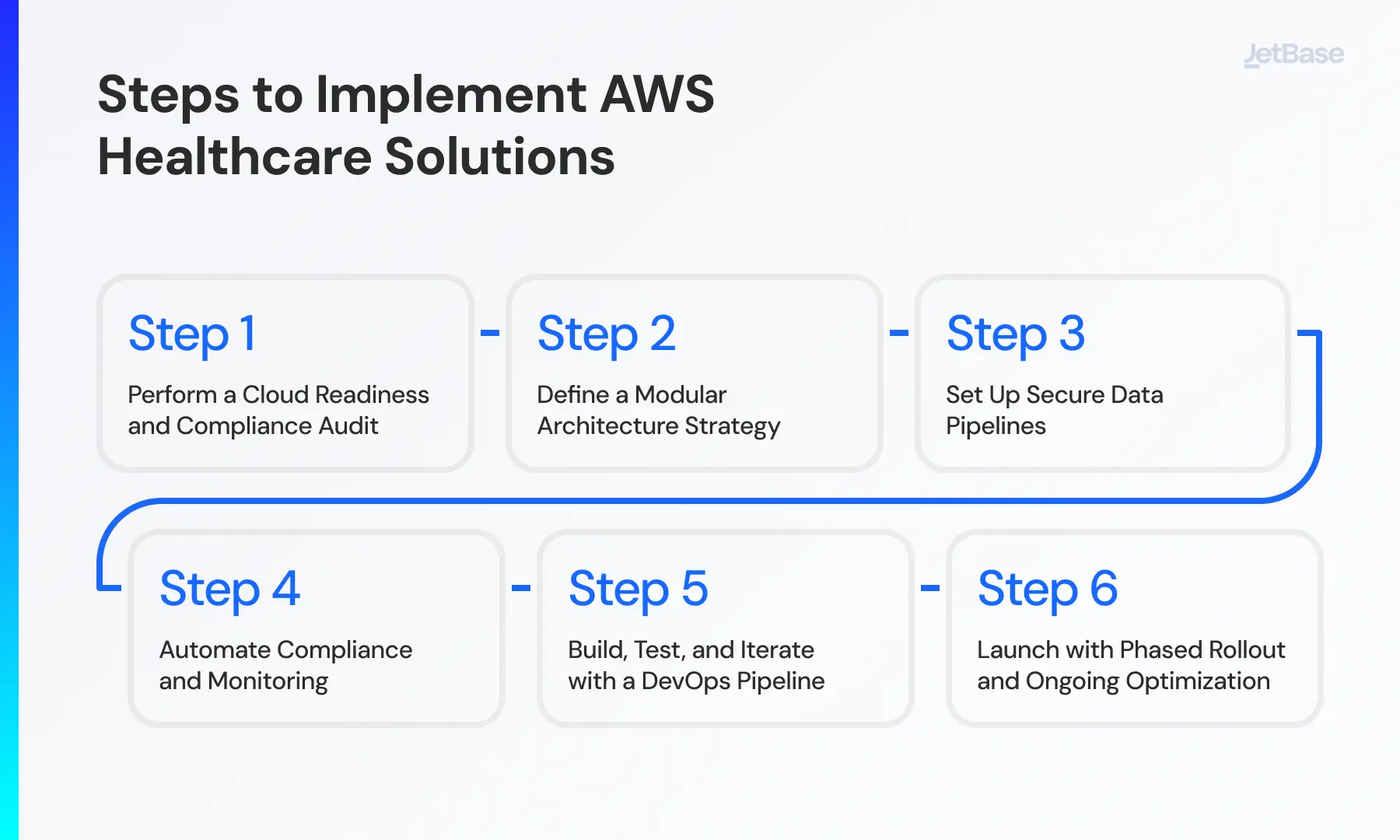
Choosing AWS for your healthcare system is only the beginning. To truly benefit from the ecosystem, you need a well-structured implementation roadmap. Here's a practical guide based on our work with healthcare providers and startups building AWS-powered systems.
Step 1. Perform a Cloud Readiness and Compliance Audit
Before migrating or launching anything on AWS, assess your current IT infrastructure:
- Identify the systems and workloads that will be moved to the cloud (EHR, patient portals, RPM, imaging, etc.)
- Evaluate legacy systems for integration readiness
- Conduct a compliance gap analysis (HIPAA, GDPR, local healthcare laws)
- Assess current data encryption, backup, and access control policies
Tip: Use AWS’s Well-Architected Tool for Healthcare to benchmark your current setup against best practices.
Step 2. Define a Modular Architecture Strategy
Don’t just “move to AWS.” Design a scalable architecture that:
- Separates critical workloads (e.g., patient data vs. analytics pipelines)
- Uses microservices or containers (via ECS/EKS) for flexibility
- Integrates managed services like HealthLake, RDS, and Comprehend Medical
- Has clear entry/exit points for future third-party integrations
This will give your product the agility to evolve with patient needs and regulatory updates.
Step 3. Set Up Secure Data Pipelines
Healthcare systems require structured, secure, and efficient data movement:
- Ingest data from apps/devices via AWS Kinesis or IoT Core
- Process data through AWS Glue (ETL)
- Store in compliant formats using HealthLake or S3 with encryption
- Apply analytics using SageMaker or QuickSight
Use IAM + Macie + GuardDuty for strict access control and anomaly detection.
Step 4. Automate Compliance & Monitoring
To reduce the risk of human error and failed audits:
- Use AWS Config + CloudTrail for continuous compliance monitoring
- Apply Amazon Inspector for vulnerability scans
- Configure CloudWatch for real-time logging and alerts
- Enable backups, versioning, and data retention policies for all critical resources
If you’re working in multiple regions, ensure compliance policies are replicated consistently.
Step 5. Build, Test, and Iterate with a DevOps Pipeline
Set up a CI/CD pipeline with:
- CodePipeline or Jenkins + CodeDeploy
- Blue/green deployment setup for zero-downtime rollouts
- Automated unit/integration testing
- Environment provisioning with CloudFormation or Terraform
This shortens your time-to-market while improving reliability and rollback safety.
Step 6. Launch with Phased Rollout and Ongoing Optimization
Start small. Pick a limited geography, user group, or use case to roll out:
- Validate performance, compliance, and usage metrics
- Use CloudWatch dashboards and X-Ray to trace and optimize performance
- Collect clinician and patient feedback early
- Plan iterations based on real-world data
Remember: AWS evolves quickly. Schedule regular AWS Well-Architected reviews every 6–12 months to identify improvements.
Need AWS Healthcare Experts?
We’ve shown you just how transformative AWS healthcare tools can be for a business, and all you need to do now is integrate them into your ecosystem. In order to guarantee you get the most out of this suite of instruments, you can recruit professional help from JetBase.
Our decade-plus of experience with custom software development has made us experts in this industry. We’ve worked on medical solutions powered by AWS to deliver modern, reliable, and effective apps. Our team would be happy to do the same for you, tackling any AWS-related challenge you set before us. Let’s start off our collaboration with a simple consultation. Just get in touch.